


Page 96 - JCTR-11-3
P. 96
Journal of Clinical and
            Translational Research                                                Household arsenic and bladder cancer


            Questions covered tobacco smoking, type of neighborhood   Table 1. Demographic characteristics of patients with
            (urban/suburban/rural), degree of drive-by automobile   urothelial cell carcinoma and control patients with benign
            traffic, frequency of home herbicide and insecticide use,   urologic disease
            primary drinking water sources, and the presence of a   Characteristic  UCC patients     Benign
            treated lumber deck, swimming pool, or wood-burning                        n=25        controls n=25
            fireplace. Each questionnaire was assigned a unique   Age range
            household study ID to protect patient confidentiality.
                                                                41 – 50                 1               2
            2.4. Area deprivation and urbanicity                51 – 60                 0               2
            We used the area deprivation index (ADI) as an indicator of   61 – 70       10              6
            socioeconomic status for each patient. The ADI incorporates   71 – 80       13             14
            aggregate income, education, employment, and housing   81+                  1               1
            quality by census block.  The online Neighborhood Atlas    Sex
                                                         ®
                               22
            tool  was used to map home addresses to ADI scores by   Male                19             20
               23
            national  percentiles.  A  higher  ADI  and  larger  national   Female      6               5
            percentiles indicate greater poverty and deprivation based
            on income, education, employment, and housing quality.   Race
            Compiled data from the Neighborhood Atlas were available   Caucasian        23             24
            from 2017 to 2021. To assess urbanicity, we assigned the   No response      2               1
            United States Department of Agriculture Rural-Urban   Ethnicity
            Continuum Codes (RUCC) based on each patient’s      Non-Hispanic            23             20
            home address. For this system, codes 1 – 3 correspond to   Hispanic         0               1
            metropolitan (urban) areas and codes 4 – 9 correspond to   No response      2               4
            increasingly rural areas.  The United States Department of   Highest educational level
                               24
            Agriculture RUCC data were available for 2023. 25
                                                                Post-college            2              13*
            2.5. Statistical analyses                           Four-year college       8               2

            Questionnaire data were encoded as categorical outcomes   Some college      7               6
            and  compared  between  cases  and  controls  using  Chi-  High school      6               3
            square or Fisher’s exact tests, with odds ratios (OR) and   No response     2               1
            95% confidence intervals (CI). Urinary 3-HPMA and   Annual income a
            iAs species, arsenic concentrations in dust and drinking   <$52,000         4               1
            water, and national percentiles for the ADI and RUCC
            were compared between UCC cases and benign urologic   $52,000 – 156,000     16             16
            controls using Mann–Whitney tests. Urinary and      >$156,000               1               6
            household chemical concentrations were correlated across   No response      4               2
            all patients by ADI and RUCC using Spearman correlation   Median years lived at   22 years    20 years
            tests.                                             current address (range)  (1 – 49 years)  (5 – 48 years)
                                                               Notes:  Annual income in USD; *indicates statistical significance at
                                                                    a
              Total urinary iAs and 3-HPMA concentrations for each   p=0.0013.
            patient were compared to in vitro genotoxic thresholds in   Abbreviation: UCC: Urothelial cell carcinoma.
            primary human urothelial cells: 10 μM for iAs and 1.1 μM
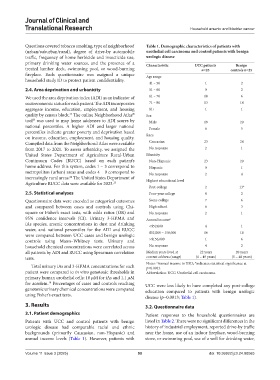
            for acrolein.  Percentages of cases and controls reaching   UCC were less likely to have completed any post-college
                      18
            genotoxic urinary chemical concentrations were compared   education compared to patients with benign urologic
            using Fisher’s exact tests.                        disease (p=0.0013; Table 1).
            3. Results                                         3.2. Questionnaire data
            3.1. Patient demographics                          Patient responses to the household questionnaires are
            Patients with UCC and control patients with benign   listed in Table 2. There were no significant differences in the
            urologic disease had comparable racial and ethnic   history of industrial employment, reported drive-by traffic
            backgrounds (primarily Caucasian, non-Hispanic) and   near the home, use of an indoor fireplace, wood-burning
            annual income levels (Table 1). However, patients with   stove, or swimming pool, use of a well for drinking water,


            Volume 11 Issue 3 (2025)                        90                            doi: 10.36922/jctr.24.00065

