


Page 98 - JCTR-11-3
P. 98
Journal of Clinical and
            Translational Research                                                Household arsenic and bladder cancer


                                                               arsenic was positively correlated with urinary iAs across
                                                               all subjects (r = 0.41; p=0.004; Figure 3B). There was no
                                                               significant difference in  household dust  arsenic  between
                                                               households reporting moderate-to-heavy traffic versus
                                                               minimal traffic (p=0.86, data not shown).
                                                                 Concentrations of arsenic in drinking water ranged
                                                               from <0.04 to 5.05  μg/L, with no significant difference
                                                               between case (median: 0.135 μg/L) and control households
                                                               (median: 0.123  μg/L;  p=0.61;  Figure  4). Arsenic in
                                                               drinking water did not correlate with iAs across all subjects
                                                               (r = −0.24, p=0.28).

                                                               3.5. Urine cotinine
                                                               Three UCC patients and two controls had detectable
                                                               cotinine levels in their urine, ranging from 2 to 5,473 ng/mg
                                                               creatinine. Of these five individuals, four were former
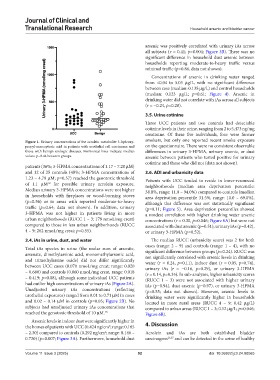
            Figure 1. Urinary concentrations of the acrolein metabolite 3-hydroxy-  smokers, but only one reported recent smoke exposure
            propyl-mercapturic acid in patients with urothelial cell carcinoma and   on the questionnaire. There were no consistent observable
            those with benign urologic diseases. Horizontal lines indicate median   differences in urinary 3-HPMA, urinary arsenic, or dust
            values. p=0.44 between groups.                     arsenic between patients who tested positive for urinary
                                                               cotinine and those who did not (data not shown).
            patients (36%; 3-HPMA concentrations of 1.17 – 7.20 μM)
            and 12 of 25 controls (48%; 3-HPMA concentrations of   3.6. ADI and urbanicity data
            1.23 – 4.79 μM; p=0.57) reached the genotoxic threshold   Patients with UCC tended to reside in lower-resourced
            of 1.1  μM  for possible urinary acrolein exposure.   neighborhoods (median area deprivation percentile:
                     18
            Median urinary 3-HPMA concentrations were not higher   38.0%, range: 11.0 – 94.0%) compared to controls (median
            in households with fireplaces or wood-burning stoves   area deprivation percentile 31.5%, range: 10.0 – 69.0%),
            (p=0.56) or in areas with reported moderate-to-heavy   although this difference was not statistically significant
            traffic (p=0.64; data not shown). In addition, urinary   (p=0.11;  Figure  5). Area deprivation percentiles showed
            3-HPMA was not higher in patients living in more   a modest correlation with higher drinking water arsenic
            urban neighborhoods (RUCC 1 – 3; 179 nmoL/mg creat)   concentrations (r = 0.30, p=0.046; Figure 6A) but were not
            compared to those in less urban neighborhoods (RUCC   associated with dust arsenic (p=0.51), urinary iAs (p=0.42),
            4 – 9; 262 nmoL/mg creat; p=0.55).                 or urinary 3-HPMA (p=0.52).

            3.4. iAs in urine, dust, and water                   The median RUCC (urbanicity score) was 2 for both
                                                               cases (range: 2 – 9) and controls (range: 1 – 4), with no
            Total iAs species in  urine (the molar  sum of arsenite,
            arsenate, dimethylarsinic acid, monomethylarsonic acid,   significant difference between groups (p=0.24). RUCC was
                                                               not significantly correlated with arsenic levels in drinking
            and trimethylarsine oxide) did not differ significantly   water (r = 0.24, p=0.11), indoor dust (r = 0.05, p=0.74),
            between UCC cases (0.070 nmoL/mg creat; range: 0.020   urinary iAs (r = −0.16,  p=0.29), or urinary 3-HPMA
            – 0.680) and controls (0.060 nmoL/mg creat, range: 0.018   (r = 0.14, p=0.35). In sub-analyses, higher urbanicity scores
            – 0.419; p=0.08), although some individual UCC patients   (RUCC  1 – 3) were  not associated with higher urinary
            had outlier high concentrations of urinary iAs (Figure 2A).   iAs (p=0.94), dust arsenic (p=0.97), or urinary 3-HPMA
            Unadjusted urinary iAs  concentrations (reflecting   (p=0.55; data not shown). However, arsenic levels in
            urothelial exposures) ranged from 0.01 to 0.71 μM in cases   drinking water were significantly higher in households
            and 0.02 – 0.14 μM in controls (p=0.05; Figure 2B). No   located in more rural areas (RUCC 4 – 9; 0.42  μg/L)
            subjects had unadjusted urinary iAs concentrations that   compared to urban areas (RUCC 1 – 3; 0.12 μg/L; p=0.046;
            reached the genotoxic threshold of 10 μM. 18       Figure 6B).
              Arsenic levels in indoor dust were significantly higher in
            the homes of patients with UCC (0.424 ng/cm ; range: 0.165   4. Discussion
                                               2
            – 2.30) compared to controls (0.292 ng/cm ; range: 0.146 –   Acrolein and iAs are both established bladder
                                              2
            0.730) (p=0.007; Figure 3A). Furthermore, household dust   carcinogens 26,27  and can be detected in the urine of healthy

            Volume 11 Issue 3 (2025)                        92                            doi: 10.36922/jctr.24.00065

