


Page 99 - JCTR-11-3
P. 99
Journal of Clinical and
            Translational Research                                                Household arsenic and bladder cancer


                        A                                    B


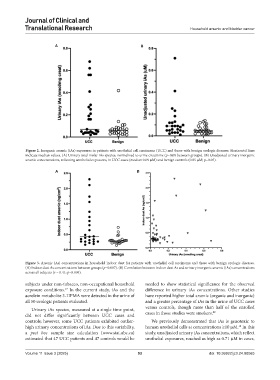
            Figure 2. Inorganic arsenic (iAs) exposures in patients with urothelial cell carcinoma (UCC) and those with benign urologic diseases. Horizontal lines
            indicate median values. (A) Urinary total molar iAs species, normalized to urine creatinine (p=0.08 between groups). (B) Unadjusted urinary inorganic
            arsenic concentrations, reflecting urothelial exposures, in UCC cases (median 0.09 μM) and benign controls (0.05 μM; p=0.05).

                         A                                 B


            Figure 3. Arsenic (As) concentrations in household indoor dust for patients with urothelial cell carcinoma and those with benign urologic diseases.
            (A) Indoor dust As concentrations between groups (p=0.007). (B) Correlation between indoor dust As and urinary inorganic arsenic (iAs) concentrations
            across all subjects (r = 0.41; p=0.004).

            subjects under non-tobacco, non-occupational household   needed to show statistical significance for the observed
            exposure conditions.  In the current study, iAs and the   difference  in  urinary iAs concentrations.  Other  studies
                             17
            acrolein metabolite 3-HPMA were detected in the urine of   have reported higher total arsenic (organic and inorganic)
            all 50 urologic patients evaluated.                and a greater percentage of iAs in the urine of UCC cases
              Urinary iAs species, measured at a single time point,   versus  controls,  though  more  than  half  of  the  enrolled
                                                                                            28
            did not differ significantly between UCC cases and   cases in those studies were smokers.
            controls; however, some UCC patients exhibited outlier-  We previously demonstrated that iAs is genotoxic to
            high urinary concentrations of iAs. Due to this variability,   human urothelial cells at concentrations ≥10 μM.  In this
                                                                                                      18
            a  post  hoc sample  size  calculation (www.stat.ubc.ca)   study, unadjusted urinary iAs concentrations, which reflect
            estimated that 47 UCC patients and 47 controls would be   urothelial exposures, reached as high as 0.71 μM in cases,


            Volume 11 Issue 3 (2025)                        93                            doi: 10.36922/jctr.24.00065

