


Page 20 - JCTR-11-4
P. 20
Journal of Clinical and
            Translational Research                                                          Hidden cancer after VTE


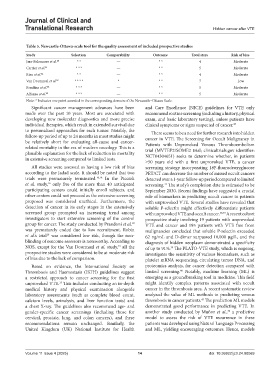
            Table 5. Newcastle‑Ottawa‑scale tool for the quality assessment of included prospective studies
            Study              Selection      Comparability       Outcome          Total stars     Risk of bias
            Jara-Palomares et al. 20  * *          ―                 * *              4             Moderate
            Carrier et al. 21    * * *             ―                 * *              5             Moderate
            Rieu et al. 22        * *              ―                 * *              4             Moderate
            Van Doormaal et al. 23  * * * *        *                 * *              7               Low
            Rondina et al. 24    * * *             ―                 * *              5             Moderate
            Alfonso et al. 25    * * *             ―                 * *              5             Moderate
            Note: * Indicates one point awarded in the corresponding domain of the Newcastle–Ottawa Scale.
              Significant cancer management advances have been   and Care Excellence (NICE) guidelines for VTE only
            made over the past 10  years. Most are associated with   recommend routine screening (including a history, physical
            developing new molecular diagnostics and more precise   exam, and basic laboratory testing), unless patients have
            individual therapies, which result in extended survival due   clinical symptoms or signs suspected of cancer. 36
            to personalized approaches for each tumor. Notably, the   There seems to be a need for further research into hidden
            follow-up period of up to 24 months in most studies might   cancer in VTE. The Screening for Occult Malignancy in
            be relatively short for evaluating all-cause and cancer-  Patients with Unprovoked Venous Thromboembolism
            related mortality in the era of modern oncology. This is a   trial (MVTEP2/SOME2 trial; clinicaltrials.gov identifier:
            plausible explanation for the lack of reduction in mortality   NCT04304651) seeks to determine whether, in patients
            in extensive screening compared to limited tests.
                                                               ≥50  years old with a first unprovoked VTE, a cancer
              All studies were assessed as having a low risk of bias   screening strategy incorporating 18F-fluorodeoxyglucose
            according to the Jadad scale. It should be noted that two   PET/CT can decrease the number of missed occult cancers
            trials were prematurely terminated. 16,18  In the Piccioli   detected over a 1-year follow-up period compared to limited
            et  al. study,  only five of the more than 40 anticipated   screening.  The study’s completion date is estimated to be
                     16
                                                                       37
            participating centers could initially enroll subjects, and   September 2030. Recent findings have suggested a crucial
            other centers could not proceed as the extensive screening   role of biomarkers in predicting occult cancer in patients
            proposed was considered unethical. Furthermore, the   with unprovoked VTE. Several studies have revealed that
            detection of cancer in its early stages in the extensively   soluble P-selectin might effectively differentiate patients
            screened group prompted an  increasing  trend among   with unprovoked VTE and occult cancer. 38,39  A recent cohort
            investigators to start extensive screening of the control   prospective study involving 19 patients with unprovoked
            group for cancer. The study conducted by Prandoni et al.    VTE and cancer  and 195  patients with VTE  free from
                                                         18
            was prematurely ended due to low recruitment. Robin   malignancies concluded that soluble P-selectin exceeded
            et al.’s trial  was considered low risk, though the non-  62  ng/mL and D-dimer surpassed 10,000  µg/L, and the
                     19
            blinding of outcome assessors is noteworthy. According to   diagnosis of hidden neoplasm demonstrated a specificity
            NOS, except for the Van Doormaal et al. study,  all the   of up to 91%.  The PLATO-VTE study, which is ongoing,
                                                   23
                                                                          39
            prospective studies were considered to be at moderate risk   investigates the sensitivity of various biomarkers, such as
            of bias due to the lack of comparison.             platelet mRNA sequencing, circulating tumor DNA, and
              Based on evidence, the International Society on   proteomics analysis, for cancer detection compared with
                                                                              40
            Thrombosis  and  Haemostasis  (ISTH)  guidelines  suggest   limited screening.  Notably, machine learning (ML) is
            a restricted approach to cancer screening for the first   emerging as a groundbreaking tool in medicine. This field
            unprovoked VTE.  This includes conducting an in-depth   might identify complex patterns associated with occult
                          35
            medical  history  and  physical  examination  alongside   cancer in the thrombosis area. A recent systematic review
            laboratory assessments (such as complete blood count,   analyzed the value of ML methods in predicting venous
            calcium  levels,  urinalysis,  and  liver  function  tests)  and   thrombosis in cancer patients.  The prediction ML models
                                                                                       41
            a chest X-ray. The guidelines also recommend age-  and   demonstrated good performance in predicting VTE. In
                                                                                                  42
            gender-specific cancer screenings (including those for   another study conducted by Muñoz  et al.,  a predictive
            cervical, prostate, lung, and colon cancers), and these   model to assess the risk of VTE recurrence in these
            recommendations  remain unchanged.  Similarly,  the   patients was developed using Natural Language Processing
            United  Kingdom (UK) National Institute for Health   and ML, yielding encouraging outcomes. Hence, models


            Volume 11 Issue 4 (2025)                        14                            doi: 10.36922/jctr.24.00069

