


Page 15 - JCTR-11-4
P. 15
Journal of Clinical and
            Translational Research                                                          Hidden cancer after VTE


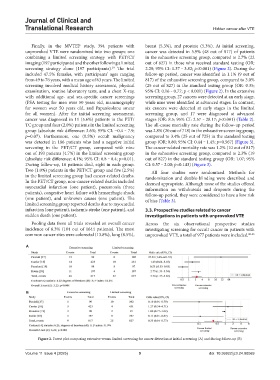
              Finally, in the MVTEP study, 394  patients with   breast (5.3%), and prostate (5.3%). At initial screening,
            unprovoked VTE were randomized into two groups: one   cancer was detected in 5.9% (48 out of 817) of patients
            combining a limited screening strategy with PET/CT   in the exhaustive screening group, compared to 2.7% (22
            imaging (197 participants) and the other following a limited   out of 827) in those who received standard testing (OR:
            screening strategy alone (197 participants).  The trial   2.28; 95% CI: 1.37 ‒ 3.82; p<0.001) (Figure 2). During the
                                                 19
            included 47.5% females, with participants’ ages ranging   follow-up period, cancer was identified in 1.1% (9 out of
            from 49 to 76 years, with a mean age of 63 years. The limited   817) of the exhaustive screening group, compared to 3.0%
            screening involved medical history assessment, physical   (25 out of 827) in the standard testing group (OR: 0.35;
            examination, routine laboratory tests, and a chest X-ray,   95% CI: 0.16 ‒ 0.77; p < 0.001) (Figure 2). In the extensive
            with additional age-  and sex-specific cancer screenings   screening group, 27 cancers were detected at an early stage,
            (PSA testing for men over 50  years old, mammography   while nine were identified at advanced stages. In contrast,
            for women over 50  years old, and Papanicolaou smear   six  cancers were detected at early stages in  the limited
            for all women). After the initial screening assessment,   screening group, and 17 were diagnosed at advanced
            cancer was diagnosed in 11 (5.6%) patients in the PET/  stages (OR: 8.5; 95% CI: 2.57 ‒ 28.17; p<0.001) (Table 2).
            TC group and four (2.0%) patients in the limited screening   The all-cause mortality rate during the follow-up period
            group (absolute risk difference: 3.6%; 95% CI: −0.4 ‒ 7.9;   was 2.8% (20 out of 718) in the exhaustive screening group,
            p=0.07). Furthermore, one (0.5%) occult malignancy   compared to 3.4% (25 out of 725) in the standard testing
            was  detected  in  186  patients  who  had  a  negative  initial   group (OR: 0.80; 95% CI: 0.44 ‒ 1.45; p=0.567) (Figure 3).
            screening in the PET/CT group, compared with nine   The cancer-related mortality rate was 1.2% (10 out of 817)
            out of 193 patients (4.7%) in the limited screening group   in the exhaustive screening group, compared to 2.3% (19
            (absolute risk difference: 4.1%; 95% CI: 0.8 ‒ 8.4; p=0.01).   out of 827) in the standard testing group (OR: 1.07; 95%
            During follow-up, 16 patients died, eight in each group.   CI: 0.57 ‒ 2.00; p=0.143) (Figure 3).
            Two (1.0%) patients in the PET/CT group and five (2.5%)   All  four  studies  were  randomized. Methods for
            in the limited screening group had cancer-related deaths.   randomization and double-blinding were described and
            In the PET/CT group, non-cancer-related deaths included   deemed appropriate. Although none of the studies offered
            myocardial infarction (one patient), pneumonia (three   information on withdrawals and dropouts during the
            patients), congestive heart failure with hemorrhagic shock   follow-up period, they were considered to have a low risk
            (one  patient),  and  unknown  causes  (one  patient).  The   of bias (Table 3).
            limited screening group reported deaths due to myocardial
            infarction (one patient), ischemic stroke (one patient), and   3.3. Prospective studies related to cancer
            sudden death (one patient).                        investigations in patients with unprovoked VTE
              Pooling data from all trials revealed an overall cancer   Across  the  six  observational  prospective  studies
            incidence of 6.3% (104 out of 1644  patients). The most   investigating screening for occult cancer in patients with
            common cancer sites were colorectal (13.8%), lung (8.5%),   unprovoked VTE, a total of 977 patients were included. 20-25

            A


            B


                 Figure 2. Forest plot comparing extensive versus limited screening for cancer detection at initial screening (A) and during follow-up (B)


            Volume 11 Issue 4 (2025)                        9                             doi: 10.36922/jctr.24.00069

