


Page 17 - JCTR-9-4
P. 17
AboEl-Azm et al. | Journal of Clinical and Translational Research 2023; 9(4): 222-235   233


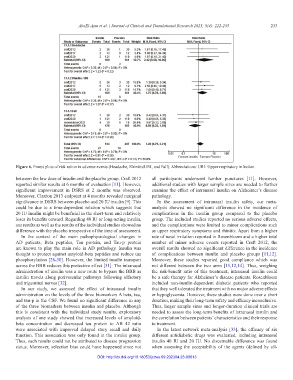
        Figure 6. Forest plots of risk ration in adverse events (Headache, Rhinitis/URI, and Fall). Abbreviations: URI: Upper respiratory infection.

        between the low dose of insulin and the placebo group. Craft 2012   all  participants  underwent  lumbar  punctures  [11].  However,
        reported similar results at 6 months of evaluation [11]. However,   additional studies with larger sample sizes are needed to further
        significant  improvement  in  DSRS  at  2  months  was  observed.   examine the effect of intranasal insulin on Alzheimer’s disease
        Moreover, Claxton 2013 endpoint at 4 months revealed marginal   pathology.
        significance in DSRS between placebo and 20 IU insulin [9]. This   In  the  assessment  of  intranasal  insulin  safety,  our  meta-
        could  be  due  to  a  time-dependent  relation  which  suggests  that   analysis  showed  no  significant  difference  in  the  incidence  of
        20 IU insulin might be beneficial in the short-term and relatively   complications  in  the  insulin  group  compared  to  the  placebo
        loses its benefits onward. Regarding 40 IU or long-acting insulin,   group. The included studies reported no serious adverse effects,
        our results as well as the results of the individual studies showed no   and the complications were limited to minor complications such
        difference with the placebo irrespective of the time of assessment.  as upper respiratory symptoms and rhinitis. Apart from a higher
          In  the  context  of  the  main  pathophysiological  changes  in   rate of nasal irritation reported in Rosenbloom and a higher total
        AD  patients,  Beta  peptides,  Tau  protein,  and  Tau-p  protein   number  of  minor  adverse  events  reported  in  Craft  2012,  the
        are known to play the main role in AD pathology. Insulin was   overall results showed no significant difference in the incidence
        thought to protect against amyloid-beta peptides and reduce tau   of  complications  between  insulin  and  placebo  groups  [11,12].
        phosphorylation [28-30]. However, the limited insulin transport   Moreover,  these  studies  reported  good  compliance  which  was
        across the BBB reduces this protective effect [31]. The intranasal   not different between the two arms [11,12,14]. Thus, weighing
        administration of insulin was a new route to bypass the BBB as   the  risk-benefit  ratio  of  this  treatment,  intranasal  insulin  could
        insulin  travels  along  perivascular  pathways  following  olfactory   be a safe therapy for Alzheimer’s disease patients. Rosenbloom
        and trigeminal nerves [32].                             included  non-insulin-dependent  diabetic  patients  who  reported
          In  our  study,  we  assessed  the  effect  of  intranasal  insulin   that they well tolerated the treatment with no major adverse effects
        administration on the levels of the three biomarkers A beta, tau,   or hypoglycemia. However, these studies were done over a short
        and tau-p in the CSF. We found no significant difference in any   duration, making their long-term safety and efficacy inconclusive.
        of the three biomarkers between insulin and placebo. Although   Thus, larger sample sizes and longer-duration clinical trials are
        this  is  consistent  with  the  individual  study  results,  exploratory   needed to assess the long-term benefits of intranasal insulin and
        analysis of one study showed that increased levels of amyloid-  the correlation between patients’ characteristics and their response
        beta  concentration  and  decreased  tau  protein–to–AB  42  ratio   to treatment.
        were  associated  with  improved  delayed  story  recall  and  daily   In  the  latest  network  meta-analysis  [33],  the  efficacy  of  six
        function. This association was only found in the insulin group.   different  antidiabetic  drugs  was  evaluated,  including  intranasal
        Thus, such results could not be attributed to disease progression   insulin 40 IU and 20 IU. No discernable difference was found
        status. Moreover, selection bias could have happened since not   when  assessing  the  acceptability  of  the  agents  (defined  by  all-
                                          DOI: http://dx.doi.org/10.18053/jctres.09.202304.23-00013

