


Page 22 - JCTR-9-4
P. 22
238                       Marchand et al. | Journal of Clinical and Translational Research 2023; 9(4): 236-245
        that resulted in a neonate who was born alive, and this ratio was   We  could  not  assess  publication  bias  using  the  funnel  plot
        calculated to 100 embryo transfers.                     method, and Egger’s test is considered unreliable for less than ten
          Two  authors  evaluated  the  methodological  quality  and  the   included studies [34,35].
        risk of bias in included studies using the Cochrane risk of bias
        assessment  tool  [33].  This  tool  involves  six  domains  as  the   3. Results
        following: selection bias, performance bias (blinding of participant   3.1. Results of the literature search
        and personnel), detection bias (blinding of outcome assessment),
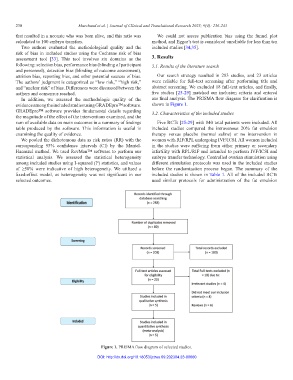
        attrition bias, reporting bias, and other potential sources of bias.   Our  search  strategy  resulted  in  283  studies,  and  23  articles
        The authors’ judgment is categorized as “low risk,” “high risk,”   were  reliable  for  full-text  screening  after  performing  title  and
        and “unclear risk” of bias. Differences were discussed between the   abstract screening. We excluded 18 full-text articles, and finally,
        authors and consensus reached.                          five  studies  [25-29]  matched  our  inclusion  criteria  and  entered
          In  addition,  we  assessed  the  methodologic  quality  of  the   our final analysis. The PRISMA flow diagram for clarification is
        evidence among the included studies using GRADEpro™ software.   shown in Figure 1.
        GRADEpro™  software  provides  fundamental  details  regarding   3.2. Characteristics of the included studies
        the magnitude of the effect of the interventions examined, and the
        sum of available data on main outcomes in a summary of findings   Five RCTs [25-29] with 840 total patients were included. All
        table  produced  by  the  software.  This  information  is  useful  in   included  studies  compared  the  intravenous  20%  fat  emulsion
        examining the quality of evidence.                      therapy  versus  placebo  (normal  saline)  or  no  intervention  in
          We pooled the dichotomous data as risk ratios (RR) with the   women with RIF/RPL undergoing IVF/ICSI. All women included
        corresponding  95%  confidence  intervals  (CI)  by  the  Mantel-  in  the  studies  were  suffering  from  either  primary  or  secondary
        Haenszel method. We used RevMan™ software to perform our   infertility with RPL/RIF and intended to perform IVF/ICSI and
        statistical  analysis.  We  assessed  the  statistical  heterogeneity   embryo transfer technology. Controlled ovarian stimulation using
        among included studies using I-squared (I ) statistics, and values   different stimulation protocols was used in the included studies
                                          2
        of  ≥50%  were  indicative  of  high  heterogeneity.  We  utilized  a   before  the  randomization  process  began.  The  summary  of  the
        fixed-effect  model,  as  heterogeneity  was  not  significant  in  our   included studies is shown in Table 1. All of the included RCTs
        selected outcomes.                                      used  similar  protocols  for  administration  of  the  fat  emulsion


                                           Figure 1. PRISMA flow diagram of selected studies.
                                          DOI: http://dx.doi.org/10.18053/jctres.09.202304.23-00060

