


Page 25 - JCTR-9-4
P. 25
Marchand et al. | Journal of Clinical and Translational Research 2023; 9(4): 236-245   241
        therapy,  which  included  two  or  three  doses  of  2–4  mL  of  the   (RR = 0.78, 95% CI [0.50, 1.20], P = 0.26), as shown in Figure 6.
        20% fat emulsion each diluted in saline, given in the time period   We  found  homogeneity  among  the  pooled  studies  (P  =  0.38,
        surrounding embryo transfer [25-29]. While these protocols were   I²  =  0%).  The  quality  of  evidence  was  moderate,  as  shown  in
        similar in timing and dosage, they were not identical.  Figure 4.
        3.3. Risk of bias assessment                            3.4.4. Live birth rate

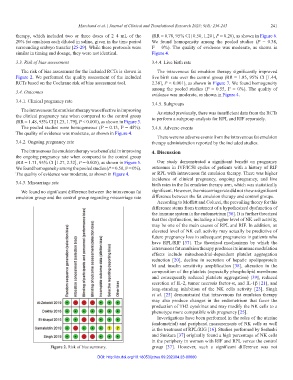
          The risk of bias assessment for the included RCTs is shown in   The intravenous fat emulsion therapy significantly improved
        Figure 2. We performed the quality assessment of the included   live birth rate over the control group (RR = 1.85, 95% CI [1.44,
        RCTs based on the Cochrane risk of bias assessment tool.  2.38], P < 0.001), as shown in Figure 7. We found homogeneity
                                                                among  the  pooled  studies  (P  =  0.55,  I²  =  0%). The  quality  of
        3.4. Outcomes
                                                                evidence was moderate, as shown in Figure 4.
        3.4.1. Clinical pregnancy rate
                                                                3.4.5. Subgroups
          The intravenous fat emulsiontherapy was effective in improving

                                                                   As stated previously, there was insufficient data from the RCTs
        the clinical pregnancy rate when compared to the control group   to perform a subgroup analysis for RPL and RIF separately.
        (RR = 1.48, 95% CI [1.23, 1.79], P < 0.001), as shown in Figure 3.
          The pooled studies were homogeneous (P = 0.13, I² = 45%).   3.4.6. Adverse events
        The quality of evidence was moderate, as shown in Figure 4.
                                                                   There were no adverse events from the intravenous fat emulsion
        3.4.2. Ongoing pregnancy rate                           therapy administration reported by the included studies.
          The intravenous fat emulsion therapy was beneficial in improving   4. Discussion
        the ongoing pregnancy rate when compared to the control group
        (RR = 1.71, 95% CI [1.27, 2.32], P = 0.005), as shown in Figure 5.   Our  study  demonstrated  a  significant  benefit  on  pregnancy
        We found homogeneity among the pooled studies (P = 0.50, I² = 0%).   outcomes in IVF/ICSI cycles of patients with a history of RIF
        The quality of evidence was moderate, as shown in Figure 4.  or RPL with intravenous fat emulsion therapy. There was higher
                                                                incidence  of  clinical  pregnancy,  ongoing  pregnancy,  and  live
        3.4.3. Miscarriage rate                                 birth rates in the fat emulsion therapy arm, which was statistically
          We found no significant difference between the intravenous fat   significant. However, the miscarriage rate did not show a significant
        emulsion group and the control group regarding miscarriage rate   difference between the fat emulsion therapy and control groups.
                                                                   According to Moffett and Colucci, the prevailing theory for this
                                                                difference stems from treatment of a hypothesized dysfunction of
                                                                the immune system in the endometrium [36]. It is further theorized
                                                                that this dysfunction, including a higher level of NK cell activity,
                                                                may be one of the main causes of RPL and RIF. In addition, an
                                                                elevated level of NK cell activity may actually be predictive of
                                                                future pregnancy loss in subsequent pregnancies in patients who
                                                                have RPL/RIF [37].  The  theorized  mechanisms  by  which  the
                                                                intravenous fat emulsion therapy produces its immune modulation
                                                                effects  include  mitochondrial-dependent  platelet  aggregation
                                                                reduction  [20],  decline  in  secretion  of  hepatic  apolipoprotein
                                                                M  and  insulin  sensitivity  amplification  [38],  alteration  in  the
                                                                composition of the platelets (especially phospholipid membrane
                                                                and  consequently  reduced  platelets  aggregation)  [39],  reduced
                                                                secretion of IL-2, tumor necrosis factor-α, and IL-1β [21], and
                                                                long-standing  inhibition  of  the  NK  cells  activity  [23].  Singh
                                                                et al.  [25]  demonstrated  that  intravenous  fat  emulsion  therapy
                                                                may  also  produce  changes  in  the  endometrium  that  favor  the
                                                                production of TH2 cytokines and may modify the NK cells to a
                                                                phenotype more compatible with pregnancy [25].
                                                                   Investigations have been performed in the roles of the uterine
                                                                (endometrial) and peripheral measurements of NK cells as well
                                                                in the treatment of RPL/RIG [16]. Studies performed by Seshadri
                                                                and Sunkara [37] originally found a high percentage of NK cells
                                                                in the periphery in women with RIF and RPL versus the control
                      Figure 2. Risk of bias summary.           group  [37].  However,  such  a  significant  difference  was  not
                                          DOI: http://dx.doi.org/10.18053/jctres.09.202304.23-00060

