


Page 63 - JCTR-9-6
P. 63
Malakar et al. | Journal of Clinical and Translational Research 2023; 9(6): 423-432   427
                          A


                          B


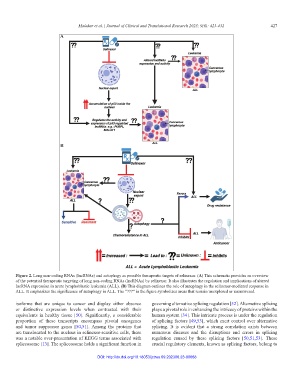
        Figure 2. Long non-coding RNAs (lncRNAs) and autophagy as possible therapeutic targets of selinexor. (A) This schematic provides an overview
        of the potential therapeutic targeting of long non-coding RNAs (lncRNAs) by selinexor. It also illustrates the regulation and implications of altered
        lncRNA expression in acute lymphoblastic leukemia (ALL). (B) This diagram outlines the role of autophagy in the selinexor-mediated response in
        ALL. It emphasizes the significance of autophagy in ALL. The “???” in the figure symbolizes areas that remain unexplored or unanswered.

        isoforms that are unique to cancer and display either absence   governing alternative splicing regulation [52]. Alternative splicing
        or distinctive  expression levels when contrasted with their   plays a pivotal role in enhancing the intricacy of proteins within the
        equivalents  in  healthy  tissue  [50].  Significantly,  a  considerable   human system [34]. This intricate process is under the regulation
        proportion of these transcripts  encompass pivotal  oncogenes   of splicing factors [49,53], which exert control over alternative
        and tumor suppressor genes  [50,51].  Among the proteins that   splicing.  It  is  evident  that  a  strong  correlation  exists  between
        are translocated to the nucleus in selinexor-sensitive cells, there   numerous  diseases  and  the  disruptions  and  errors in  splicing
        was a notable over-presentation of KEGG terms associated with   regulation  caused by these splicing factors  [50,51,53]. These
        spliceosome [13]. The spliceosome holds a significant function in   crucial regulatory elements, known as splicing factors, belong to

                                          DOI: http://dx.doi.org/10.18053/jctres.09.202306.23-00088

