


Page 64 - JCTR-9-6
P. 64
428                       Malakar et al. | Journal of Clinical and Translational Research 2023; 9(6): 423-432
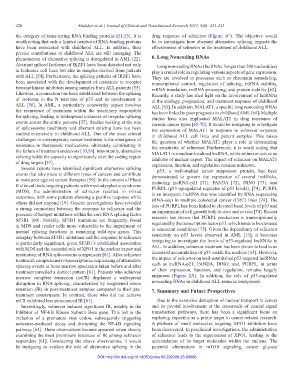
        the category of trans-acting RNA binding proteins [51,53]. It is   drug response of selinexor  (Figure  1C).  The  objective  would
        worth noting that only a limited number of RNA-binding proteins   be to investigate  how aberrant  alternative  splicing  impacts  the
        have  been  associated  with  childhood  ALL.  In  addition,  their   effectiveness of selinexor in the treatment of childhood ALL.
        precise contributions to childhood ALL are still emerging. The
        phenomenon of alternative splicing is deregulated in AML [22].   6. Long Noncoding RNAs
        Aberrant spliced Isoforms of IKZF1 have been detected not only   Long non-coding RNAs (lncRNAs: longer than 200 nucleotides)
        in leukemic cell lines but also in samples derived from patients   play a crucial role in regulating various aspects of gene expression.
        with ALL [54]. Furthermore, the splicing patterns of IKZF1 have   They are involved in processes such as chromatin remodeling,
        been associated with the development  of resistance to receptor   transcriptional  control,  regulation  of  splicing,  mRNA  stability,
        tyrosine kinase inhibitors among samples from ALL patients [55].   mRNA translation, miRNA processing, and protein stability [62].
        Likewise, a connection has been established between the splicing   Recently, a study has shed light on the involvement of lncRNAs
        of  isoforms  in  the  N  terminus  of  p53  and  its  involvement  in   in the etiology, progression, and treatment response of childhood
        ALL [56].  In AML,  a  particularly  noteworthy  aspect  involves   ALL [63]. In addition, MALAT1, a specific long noncoding RNAs
        the recurrence  of mutations  within the machinery  responsible   has been linked to poor prognosis in childhood AML [64]. Multiple
        for splicing, leading to widespread instances of irregular splicing   studies  have also implicated MALAT1  in drug resistance  of
        events across the entire genome [57]. Studies looking at the role   various cancer types [65-70]. It would be intriguing to investigate
        of spliceosome  machinery  and aberrant  splicing  have not been   the expression of MALAT1 in response to selinexor exposure
        studied extensively in childhood ALL. One of the most critical   in childhood  ALL cell lines and patient samples.  This raises
        challenges in contemporary cancer treatment is the emergence of   the question of whether MALAT1 plays a role in determining
        resistance to therapeutic medications, ultimately culminating in   the sensitivity of selinexor. Furthermore, it is worth noting that
        the failure of treatment endeavors [10,58]. Importantly, alternative   MALAT1 is a nuclear-localized lncRNA, while selinexor acts as an
        splicing holds the capacity to significantly alter the coding region   inhibitor of nuclear export. The impact of selinexor on MALAT1
        of drug targets [57].                                   expression, function, and regulation remains unknown.
          Several reports have identified significant alternative splicing
                                                                   p53,  a  well-studied  tumor  suppressor  protein,  has  been
        events that take place in different types of cancers and contribute   demonstrated  to  govern  the  expression  of  several  lncRNAs,
        to resistance against cancer therapies [59]. In the context of Phase   including  lncRNA-p21  [71],  PANDA  [72],  DINO  [73], and
        II clinical trials targeting patients with myelodysplastic syndrome   PURPL (p53 upregulated regulator of p53 levels), [74]. PURPL
        (MDS), the  administration  of selinexor  resulted  in  mixed   is an intergenic lncRNA that was identified by RNA sequencing
        outcomes, with some patients showing a positive response while   (RNA-seq) in multiple colorectal cancer (CRC) lines [74]. The
        others did not respond [19]. Genetic investigations have revealed   loss of PURPL has been linked to elevated basal levels of p53 and
        a strong connection between  the response to selinexor  and the   an impairment of cell growth both in vitro and in vivo [74]. Recent
        presence of hotspot mutations within the core RNA splicing factor
        SF3B1  [60].  Notably,  SF3B1  mutations  are  frequently  found   research has shown that PURPL production is transcriptionally
        in MDS and render cells more vulnerable to the impairment of   regulated by the transcription factor p53, which tends to be elevated
        normal  splicing  functions  in  remaining  wild-type  genes.  This   in senescent conditions [75]. Given the dependency of selinexor
        interplay between SF3B1 mutations and the response to selinexor   sensitivity  on  p53  levels  observed  in  AML  [13], it  becomes
        is particularly significant, given SF3B1’s established association   intriguing to investigate the levels of p53-regulated lncRNAs in
        with MDS and the essential role of XPO1 in the nuclear export and   ALL. In addition, selinexor treatment has been shown to lead to an
        maturation of RNA spliceosome components [61]. After selinexor   increased accumulation of p53 inside the nucleus [13]. However,
        treatment, comprehensive transcriptomic sequencing of alternative   the impact of selinexor on well-established p53-targeted lncRNAs
        splicing events in bone marrow specimens taken before and after   such  as  lncRNA-p21,  PANDA,  DINO,  and,  PURPL,  in  terms
        treatment unveiled a distinct pattern [61]. Patients who achieved   of their expression, function, and regulation,  remains largely
        marrow complete  remission  (mCR) displayed  a widespread   unknown (Figure  2A).  In  addition,  the  role  of  p53-regulated
        disruption in RNA splicing, characterized by heightened intron   noncoding RNAs in childhood ALL remains unexplored.
        retention (IR) in post-treatment samples compared to their pre-  7. Summary and Future Prospectives
        treatment  counterparts.  In  contrast,  those  who  did  not  achieve
        mCR exhibited less pronounced IR [61].                     Due to the extensive disruption of nuclear transport in cancer
          Interestingly, selinexor induced significant IR, notably in the   and  its  pivotal  involvement  at  the  crossroads of  crucial  signal
        Inhibitor  of  NF-kB  Kinase  Subunit  Beta  gene.  This  led  to  the   transduction  pathways,  there  has  been  a  significant  focus  on
        inclusion of a premature  stop codon, subsequently triggering   exploring exportins as a prime target in cancer-related research.
        nonsense-mediated  decay  and  disrupting  the  NF-kB  signaling   A  plethora  of  small  molecules  targeting  XPO1  inhibition  have
        pathway [61]. These observations became apparent when closely   been discovered. In preclinical investigations, the administration
        examining the most prominent instances of IR among selinexor   of  selinexor  leads  to  the  suppression  of  XPO1,  leading  to  the
        responders [61]. Considering the above observations, it would   accumulation  of its target molecules  within the nucleus.  The
        be intriguing to explore the role of alternative  splicing  in the   potential  alternations  in mTOR signaling,  cancer  glucose
                                          DOI: http://dx.doi.org/10.18053/jctres.09.202306.23-00088

