


Page 104 - MI-1-1
P. 104
Microbes & Immunity                                                Factors associated with response to T-VEC


            Table 1. Demographic patient and treatment data    Table 1. (Continued)
            Variable                            Overall cohort   Variable                          Overall cohort
                                                  (N=18)                                             (N=18)
            Age at diagnosis (mean years [range])    70 (51 – 86)  Burden of disease  (n [%])
                                                                           a
            Age at T-VEC injections (mean years [range])    72 (54 – 92)  High                      7 (38.8%)
            Sex (n [%])                                         Low                                 11 (61.1%)
             Male                                 11 (61.1%)   Number of treated lesions (n [%])
             Female                               7 (38.8%)     1                                   8 (44.4%)
            Race (n [%])                                        2                                   9 (50.0%)
             Caucasian                            18 (100.0%)   ≥3                                  1 (5.55%)
             Other                                0 (0.0%)     Prior systemic therapy (n [%])
             History of melanoma (n [%])          0 (0.0%)      Yes                                 13 (72.2%)
             Maximum diameter of tumor at         3.5 (0.5 – 17)  No                                5 (27.7%)
             initiation (mean cm [range])                      Number of lines of systemic therapy (n [%])
            Stage at diagnosis (n [%])                          0                                   5 (27.2%)
             IA                                   1 (5.55%)     1                                   10 (55.5%)
             IB                                   1 (5.55%)     2                                   2 (11.1%)
             IIA                                  1 (5.55%)     ≥3                                  1 (5.55%)
             IIB                                  2 (11.1%)    Concurrent immunotherapy and
             IIC                                  1 (5.55%)    T-VEC (n [%])
             IIIB                                 1 (5.55%)     Yes                                 13 (72.2%)
             IIIC                                 11 (61.1%)    No                                  5 (27.2%)
            Stage at initiation of T-VEC injection (n [%])     Number of T-VEC cycles (mean [SD, range])   6.4 (3.7, 1 – 15)
             IIIB                                 2 (11.1%)    Duration of T-VEC treatment          3.9 (2.7, 0 – 10)
             IIIC                                 9 (50.0%)    (mean months [SD, range])
                                                                   a
             IIID                                 1 (5.55%)    Note:  Burden of disease defined as 5+tumors or any one tumor >5 cm.
                                                               Abbreviation: T-VEC: Talimogene laherparepvec.
             IV                                   6 (33.3%)
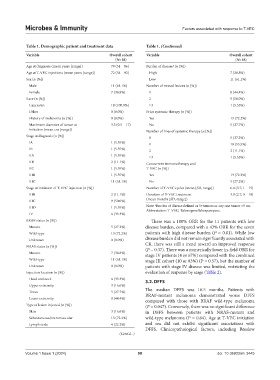
            BRAF status (n [%])                                  There was a 100% ORR for the 11  patients with low
             Mutant                               5 (27.2%)    disease burden, compared with a 43% ORR for the seven
             Wild-type                            13 (72.2%)   patients with high disease burden (P = 0.01). While low
             Unknown                              0 (0.0%)     disease burden did not remain significantly associated with
            NRAS status (n [%])                                CR, there was still a trend toward an improved response
                                                               (P = 0.37). There was a numerically lower in-field ORR for
             Mutant                               7 (38.8%)    stage IV patients (4 or 67%) compared with the combined
             Wild-type                            11 (61.1%)   stage III cohort (10 or 83%) (P = 0.57), but the number of
             Unknown                              0 (0.0%)     patients with stage IV disease was limited, restricting the
            Injection location (n [%])                         evaluation of response by stage (Table 2).
             Head and neck                        6 (33.3%)    3.2. DFFS
             Upper extremity                      3 (16.6%)
             Torso                                5 (27.7%)    The median DFFS was 16.5  months. Patients with
                                                               BRAF-mutant melanoma demonstrated worse DFFS
             Lower extremity                      8 (44.4%)    compared with those with BRAF wild-type melanoma
            Type of lesion injected (n [%])                    (P = 0.047). Conversely, there was no significant difference
             Skin                                 3 (16.6%)    in DFFS between patients with NRAS-mutant and
             Subcutaneous/Intramuscular           13 (72.2%)   wild-type melanoma (P = 0.64). Age at T-VEC initiation
             Lymph node                           4 (22.2%)    and sex did not exhibit significant associations with
                                                               DFFS. Clinicopathological factors, including Breslow
                                                    (Cont'd...)


            Volume 1 Issue 1 (2024)                         98                               doi: 10.36922/mi.3445

