


Page 33 - MI-1-1
P. 33
Microbes & Immunity                                                  The feature of bladder cancer stem cells


            in response to different microenvironment conditions,   et al. further establish a positive correlation between
            allowing them to resist host defenses or treatment-  tumor stemness and immunotherapy resistance or poor
            induced damage. These adaptations are achieved through   prognosis.  The insights into BCSCs facilitate clinicians to
                                                                       32
            mechanisms including epigenetic modifications, epithelial-  develop more effective treatment modalities and prognostic
            mesenchymal transition (EMT), immune reprogramming,   tools. This review provides a comprehensive overview of
            and metabolic reprogramming.                       BCSC biomarkers, stemness maintenance, drug resistance,
              In 1997, Bonnet and Dick from the University of Toronto   metastasis, immune evasion, metabolic reprogramming,
            in Canada successfully isolated TSCs for the first time from   and targeted therapies.
            acute myeloid leukemia.  Recent research has demonstrated   2. Biology of normal bladder tissue
                              20
            the presence of TSCs across various cancer types, including
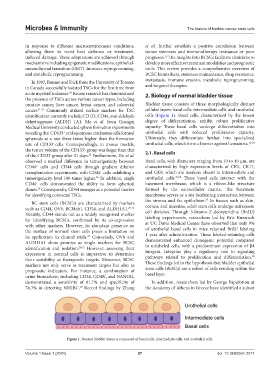
            prostate cancer, liver cancer, breast cancer, and colorectal   Bladder tissue consists of three morphologically distinct
            cancer. 21-24  Commonly utilized surface markers for TSC   cellular layers: basal cells, intermediate cells, and urothelial
            identification currently include CD133, CD44, and aldehyde   cells (Figure  1). Basal cells, characterized by the lowest
            dehydrogenase (ALDH) 1A1. Ma  et al. from Guangxi   degree of differentiation, exhibit robust proliferative
            Medical University conducted sphere formation experiments   capacity. These basal cells undergo differentiation into
            revealing that CD133  oral squamous carcinoma cells formed   urothelial  cells  with  reduced  proliferative  capacity.
                            +
            spheroids at a rate three times higher than the formation   Ultimately, they differentiate further into specialized
            rate of CD133 cells. Correspondingly, in mouse models,   urothelial cells, which form a barrier against hematuria. 33,34
                        -
            the tumor volume of the CD133  group was larger than that   2.1. Basal cells
                                     +
            of the CD133 group after 21 days.  Furthermore, Du et al.
                                       25
                      -
            observed a marked difference in tumorigenicity between   Basal cells, with diameters ranging from 10 to 40 μm, are
            CD44  cells and CD44 cells through gradient dilution   characterized  by  high  expression  levels  of  CK5,  CK17,
                +
                               -
            transplantation experiments, with CD44  cells exhibiting a   and CK8, which are markers absent in intermediate and
                                            +
            tumorigenicity level 100 times higher.  In addition, single   urothelial  cells. 35,36  These basal cells interact with the
                                          26
            CD44  cells demonstrated the ability to form spherical   basement membrane, which is a ribbon-like structure
                +
            clones.  Consequently, CD44 emerges as a potential marker   formed by the extracellular matrix. The basement
                 26
            for identifying colorectal TSCs.                   membrane serves as a site facilitating interaction between
                                                                                        37
                                                               the stroma and the epithelium.  In tissues such as skin,
              BC stem cells (BCSCs) are characterized by markers
            such as CD44, OV6, BCMab1, CD24, and ALDH1A1. 27-31    cornea, and intestine, adult stem cells undergo infrequent
            Notably, CD44 stands out as a widely recognized marker   cell division. Through 5-bromo-2’-deoxyuridine (BrdU)
            for identifying BCSCs, confirmed by its co-expression   labeling experiments, researchers led by Eric Kurzrock
            with other markers. However, its abundant presence on   at UC Davis Medical Center have observed that only 9%
            the  surface  of  normal  stem  cells  poses  a  limitation  on   of urothelial basal cells in mice retained BrdU labeling
            its application in clinical trials.  Conversely, OV6 and   1 year after administration. These labeled-retaining cells
                                      27
            ALDH1A1 show promise as single markers for BCSC    demonstrated enhanced clonogenic potential compared
            identification and isolation. 28,31  However, assessing  their   to unlabeled cells, with a predominant expression of  β4
            expression in normal cells is imperative to determine   integrin. Integrins play a regulatory role in signaling
                                                                                                            38
            their  suitability as therapeutic  targets.  Moreover,  BCSC   pathways related to proliferation and differentiation.
            markers  not  only  serve  as  treatment  targets  but  also  as   These findings led to the hypothesis that bladder epithelial
            prognostic indicators. For  instance,  a combination of   stem cells (BESCs) are a subset of cells residing within the
            urine biomarkers, including CD24, CD49f, and NANOG,   basal layer.
            demonstrated a sensitivity of 81.7% and specificity of   In addition, researchers led by George Papafotiou at
            74.3% in detecting NMIBC.  Recent findings by Zhang   the Academy of Athens in Greece have identified a subset
                                   30


                             Figure 1. Normal bladder tissue is composed of basal cells, intermediate cells, and urothelial cells.


            Volume 1 Issue 1 (2024)                         27                               doi: 10.36922/mi.2377

