


Page 35 - MI-1-1
P. 35
Microbes & Immunity                                                  The feature of bladder cancer stem cells


            CIS and MIBC originate from BESCs. Furthermore,    greater tumorgenicity compared to CD44 BC cells. In
                                                                                                  -
            gradient dilution transplantation experiments validated   addition, CD44  BC cells could give rise to both CD44 and
                                                                                                          -
                                                                           +
            the relationship between BCSCs and BESCs, with SHH +   CD44  BC cells, suggesting that CD44  cells possess the
                                                                    +
                                                                                               +
            EpCAM  cells displaying tumorigenic potential, unlike   ability to differentiate and form heterogeneous tumors,
                  +
            SHH EpCAM cells. Taken together, these observations   consistent with the characteristics of BCSCs. 27
                       +
                -
            indicate that the SHH EpCAM  cells exhibit traits of TSCs,
                                    +
                             +
            share SHH expression with BESCs, and imply a potential   In bladder tissue, CK20 serves as a marker for highly
            origin of BCSCs from BESCs. 51                     differentiated urothelial cells, while CK5 is expressed
                                                               in less differentiated basal cells. Therefore, CK5 and
            3.2. Biomarkers of BCSCs                           CK20 are considered indicative of the degree of cellular
                                                               differentiation. Building upon this hypothesis, Chan et al.
            The potential origin of BCSCs from either BESCs or                                        +
            BCNSCs suggests that these cell types may share similarities,   indicated that the molecular phenotype of CD44  BCSCs
                                                                          +
                                                                     +
                                                                                -
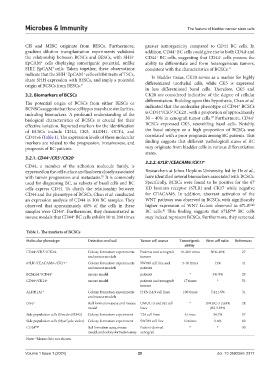
            including biomarkers. A  profound understanding of the   is CD44 /CK5 /CK20 , with a proportion of approximately
                                                                                                             +
                                                                                           27
            biological characteristics of BCSCs is crucial for their   30 – 40% in xenograft tumor cells.  Furthermore, CD44
            effective isolation. Reported markers for the identification   BCSCs expressed CK5, resembling basal cells. Notably,
            of BCSCs include CD44, CK5, ALDH1, OCT4, and       the basal subtype or a high proportion of BCSCs was
            CD44v6 (Table 1). The expression levels of these molecular   correlated with a poor prognosis among BC patients. This
            markers are related to the progression, invasiveness, and   finding suggests that different pathological states of BC
            prognosis of BC patients.                          may originate from bladder cells in various differentiation
                                                               states.
            3.2.1. CD44 /CK5 /CK20 -
                      +
                          +
                                                               3.2.2. 67LR /CEACAM6 /CK17 +
                                                                        +
                                                                                  -
            CD44, a member of the adhesion molecule family, is
            expressed on the cell surface and has been closely associated   Researchers at Johns Hopkins University, led by He et al.,
            with tumor progression and metastasis.  It is commonly   have identified several biomarkers associated with BCSCs.
                                            52
            used for diagnosing BC, as subsets of basal cells and BC   Specifically, BCSCs were found to be positive for the 67
            cells express CD44. To clarify the relationship between   KD laminin  receptor (67LR) and CK17 while negative
            CD44 and the phenotype of BCSCs, Chan et al. conducted   for  CEACAM6.  In  addition,  aberrant  activation  of  the
            an expression analysis of CD44 in 300 BC samples. They   WNT pathway was observed in BCSCs, with significantly
            observed that approximately 40% of the cells in these   higher  expression  of  WNT  factors  observed  in  67LR high
                            +
            samples were CD44 . Furthermore, they demonstrated in   BC cells.  This finding suggests that 67LR high  BC cells
                                                                      41
            mouse models that CD44  BC cells exhibit 10 to 200 times   may indeed represent BCSCs. Furthermore, they screened
                                +
            Table 1. The markers of BCSCs
            Molecular phenotype       Detection method       Tumor cell source  Tumorigenic   Stem cell ratio  References
                                                                                ability
            CD44 /CK5 /CK20-          Colony formation experiments   Patients and xenograft   10-200 times  30%-40%  27
                    +
                +
                                      and mouse models       tumors
                +
            67LR /CEACAM6-/CK17 +     Colony formation experiments   SW780 cell line and   5-10 times  15%  41
                                      and mouse models       patients
            BCMab1 /CD44 +            mouse model            patients             *        3%-5%        29
                  +
            CD90 /CK14 +              mouse model            patients and xenograft   17 times  *       53
                +
                                                             tumors
            ALDH1A1 +                 Colony formation experiments   HTB-2,4,9 cell lines  100 times  7.4±1.6%  31
                                      and mouse models
            OV6 +                     Ball formation assay and mouse  UMUC-3 and J82 cell   *  UMUC-3 2.63%  28
                                      model                  lines                        J82 3.23%
            Side population cells (Hoechst33342)  Colony formation experiment  T24 cell lines  6 times  34.7%  57
            Side population cells (DyeCycle violet) Colony formation experiment  SW780 cell line  10 times  1.6%  60
            CD24 high                 Ball formation assay, mouse   Patient-derived   *      *          30
                                      model, and colony formation assay xenograft
            Note: *Means data not shown.

            Volume 1 Issue 1 (2024)                         29                               doi: 10.36922/mi.2377

