


Page 40 - MI-1-1
P. 40
Microbes & Immunity                                                  The feature of bladder cancer stem cells


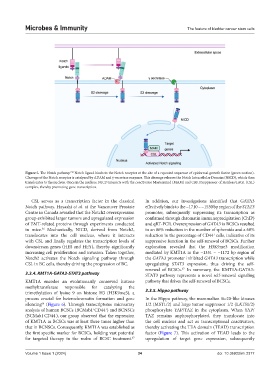
            Figure 5. The Notch pathway.  Notch ligand binds to the Notch receptor at the site of a repeated sequence of epidermal growth factor (green section).
                               150
            Cleavage of the Notch receptor is catalyzed by ADAM and γ-secretase enzymes. This cleavage releases the Notch Intracellular Domain (NICD), which then
            translocates to the nucleus. Once in the nucleus, NICD interacts with the coactivator Mastermind (MAM) and CBF1/Suppressor of Hairless/LAG1 (CSL)
            complex, thereby promoting gene transcription.

              CSL serves as a transcription factor in the classical   In addition, our investigations identified that GATA3
            Notch pathway. Hayashi et al. at the Vancouver Prostate   effectively binds to the −1710 – −1530 bp region of the STAT3
            Centre in Canada revealed that the Notch2 overexpression   promoter, subsequently suppressing its transcription as
            group exhibited larger tumors and upregulated expression   confirmed through chromatin immunoprecipitation (ChIP)
            of EMT-related proteins through experiments conducted   and qRT-PCR. Overexpression of GATA3 in BCSCs resulted
            in mice.  Mechanically, NICD, derived from Notch2,   in an 86% reduction in the number of spheroids and a 68%
                   66
            translocates into the cell nucleus, where it interacts   reduction in the percentage of CD44  cells, indicative of its
                                                                                            +
            with CSL and finally regulates the transcription levels of   suppressive function in the self-renewal of BCSCs. Further
            downstream genes (HES and HEY), thereby significantly   exploration revealed that the H3K9me3 modification
            increasing cell proliferation and invasion. Taken together,   mediated by KMT1A in the −1351 – −1172 bp region of
            Notch2 activates the Notch signaling pathway through   the GATA3 promoter inhibited GATA3 transcription while
            CSL in BC cells, thereby driving the progression of BC.  upregulating  STAT3 expression, thus driving the self-
                                                               renewal of BCSCs.  In summary, the KMT1A-GATA3-
                                                                              67
            3.3.4. KMT1A-GATA3-STAT3 pathway                   STAT3 pathway represents a novel self-renewal signaling
            KMT1A encodes an evolutionarily conserved histone   pathway that drives the self-renewal of BCSCs.
            methyltransferase  responsible  for  catalyzing  the
            trimethylation of lysine 9 on histone H3 (H3K9me3), a   3.3.5. Hippo pathway
            process crucial for heterochromatin formation and gene   In the Hippo pathway, the mammalian Ste20-like kinases
            silencing  (Figure  6). Through transcriptome microarray   1/2 (MST1/2) and large tumor suppressor 1/2 (LATS1/2)
                   66
            analysis of human BCSCs (BCMab1 CD44 ) and BCNSCs   phosphorylate YAP/TAZ in the cytoplasm. When YAP/
                                         +
                                              +
            (BCMab1 CD44 ), our group observed that the expression   TAZ  remains  unphosphorylated,  they  translocate  into
                         -
                   -
            of KMT1A in BCSCs was at least three times higher than   the cell nucleus and act as transcriptional coactivators,
            that in BCNSCs. Consequently, KMT1A was established as   thereby activating the TEA domain (TEAD) transcription
            the first specific marker for BCSCs, holding vast potential   factor (Figure  7). This activation of TEAD leads to the
            for targeted therapy in the realm of BCSC treatment.    upregulation  of  target  gene  expression,  subsequently
                                                         67
            Volume 1 Issue 1 (2024)                         34                               doi: 10.36922/mi.2377

