


Page 97 - MI-1-1
P. 97
Microbes & Immunity                                     Dynamics between phage, bacteria, and mammalian cells


            initiate the infection process. According to the findings in   Overall, our results demonstrated that the dynamics
            Figure 4D, the loss of sensitivity toward phage treatment   between  phages,  bacteria,  and mammalian cells can
            was largely attributed to the bacteria’s capability to restrict   affect the antibacterial efficiency of phages and the rate
            the adsorption of phages onto the surface. This was   of bacterial resistance development. While the findings
            consistent with the findings reported by Barr  et al. that   highlighted the positive effects of mammalian cells toward
            A. baumannii strains (AB900 and A9844) rapidly develop   phage activity, a major limitation of the present study was
            resistance against phage treatment (ΦFG02 and ΦCO01)   the  use  of  non-mucus-producing  bronchial  epithelial
            via capsule loss, thereby disrupting phage adsorption. 43  BEAS-2B cells, which is an immortalized cell line. Phages
              The interactions between bacteria and phages became   and bacteria can behave differently with other cell types,
            more complicated in the presence of epithelial cells. The   such as mucus-producing and primary lung cells, which
            previous studies have demonstrated that epithelial cells   could affect their interactions. In addition, the simple
            could also secrete chemokines and cytokines in response to   three-component co-culture system could not completely
            different stimuli to attract and stimulate the immune cells,   mimic the complex  in vivo environments. Hence, the
            thereby aggravating inflammatory conditions.  Schulz   responses toward phage treatments may not have been
                                                   44
            et al.  also demonstrated that the lipopolysaccharide   accurately represented in this study. For example, the
                45
                                                                                                            48
            (LPS), a major component of the outer membrane of gram-  generation of anti-phage neutralization antibodies
            negative bacteria, could effectively stimulate the BEAS-2B   and the modification of the microbiome during phage
                                                                       49
            and A549 epithelial cells to express immunoregulatory   treatment  may affect the effectiveness of phage therapy.
            or inflammatory cytokines, such as soluble CD14, IL-6,   Nonetheless, our findings revealed the remarkable
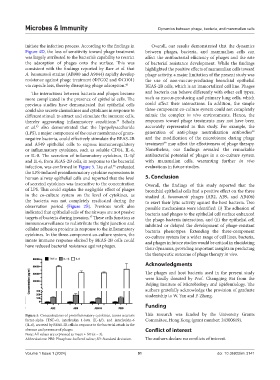
            or IL-8. The secretion of inflammatory cytokines, IL-1β   antibacterial  potential  of  phages  in  a  co-culture  system
            and IL-6, from BEAS-2B cells, in response to the bacterial   with mammalian cells, warranting further  in vivo
            infection, was confirmed in Figure 5. Liu et al.  evaluated   evaluations in future studies.
                                                 46
            the LPS-induced proinflammatory cytokine expressions in
            human airway epithelial cells and reported that the level   5. Conclusion
            of secreted cytokines was insensitive to the concentration   Overall, the findings of this study reported that the
            of LPS. This could explain the negligible effect of phages   bronchial epithelial cells had a positive effect on the three
            in  the  co-culture  system  on  the  level  of  cytokines,  as   studied  A. baumannii  phages  (AB2, AB9,  and  AB406)
            the bacteria was not completely eradicated during the   to exert their lytic activity against the host bacteria. Two
            observation period (Figure  2B). Previous work also   possible mechanisms were identified: (i) The adhesion of
            indicated that epithelial cells of the airways are not passive   bacteria and phages to the epithelial cell surface enhanced
            targets of bacteria during invasion.  These cells function as   the phage-bacteria interaction, and (ii) the epithelial cell
                                       47
            immunosurveillance to redistribute the tight junction and   inhibited or delayed the development of phage-resistant
            cellular adhesion proteins in response to the inflammatory   bacteria phenotypes. Extending the three-component
            cytokines. In the three-component co-culture system, the   co-culture system for a wider range of cell lines, bacteria,
            innate immune response elicited by BEAS-2B cells could   and phages in future studies would be critical in elucidating
            have reduced bacterial resistance against phages.  their dynamics, providing important insights in predicting

                                                               the therapeutic outcome of phage therapy in vivo.
                                                               Acknowledgments

                                                               The phages and host bacteria used in the present study
                                                               were kindly donated by Prof. Changqing Bai from the
                                                               Beijing Institute of Microbiology and Epidemiology. The
                                                               authors gratefully acknowledge the provision of graduate
                                                               studentship to W. Yan and P. Zhang.
                                                               Funding

            Figure 5. Concentrations of proinflammatory cytokines, tumor necrosis   This research was funded by the University Grants
            factor-alpha (TNF-α), interleukin 1-beta (IL-1β), and interleukin-6   Committee, Hong Kong (grant number: 24300619).
            (IL-6), secreted by BEAS-2B cells in response to the bacterial attack in the
            absence and presence of phages.                    Conflict of interest
            Note: All values are expressed as mean ± SD (n = 3).
            Abbreviations: PBS: Phosphate-buffered saline; SD: Standard deviation.  The authors declare no conflicts of interest.


            Volume 1 Issue 1 (2024)                         91                               doi: 10.36922/mi.3141

