


Page 94 - MI-1-1
P. 94
Microbes & Immunity                                     Dynamics between phage, bacteria, and mammalian cells


                         A                                 B


                         C                                   D


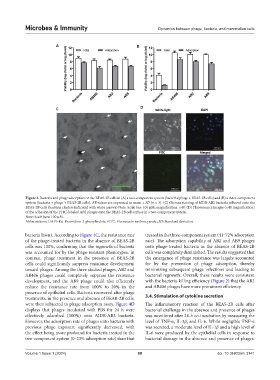
            Figure 3. Bacteria and phage adsorption on the BEAS-2B cells in (A) a two-component system (bacteria/phage + BEAS-2B cells) and (B) a three-component
            system (bacteria + phage + BEAS-2B cells). All values are expressed as mean ± SD (n = 3). (C) Giemsa staining of MDR-AB2 bacteria adhered onto the
            BEAS-2B cells (bacteria clusters indicated with white arrows) Note: Scale bar: 100 μM; magnification: ×40. (D) Fluorescence images (×40 magnification)
            of the adhesion of the FITC-labeled AB2 phages onto the BEAS-2B cell surface in a two-component system.
            Note: Scale bars: 100 μM.
            Abbreviations: DAPI: 4’,6-Diamidino-2-phenylindole; FITC: Fluorescein isothiocyanate; SD: Standard deviation.


            bacteria lawn). According to Figure 4C, the resistance rate   treated in the three-component system (41‒72% adsorption
            of the phage-treated bacteria in the absence of BEAS-2B   rate). The adsorption capability of AB2 and AB9 phages
            cells was 100%, confirming that the regrowth of bacteria   onto  phage-treated  bacteria  in  the  absence  of  BEAS-2B
            was accounted for by the phage-resistant phenotypes. In   cells was completely diminished. The results suggested that
            contrast,  phage  treatment  in  the  presence  of  BEAS-2B   the emergence of phage resistance was largely accounted
            cells could significantly suppress resistance development   for by the prevention of phage adsorption, thereby
            toward phages. Among the three studied phages, AB2 and   minimizing subsequent phage infections and leading to
            AB406 phages could completely suppress the resistance   bacterial regrowth. Overall, these results were consistent
            development, and the AB9 phage could also efficiently   with the bacteria-killing efficiency (Figure 2) that the AB2
            reduce the resistance rate from 100% to 20% in the   and AB406 phages have more prominent efficiency.
            presence of epithelial cells. Bacteria recovered after phage
            treatments, in the presence and absence of BEAB-2B cells,   3.4. Stimulation of cytokine secretion
            were then subjected to phage adsorption assay. Figure 4D   The  inflammatory  reaction  of  the  BEAS-2B  cells  after
            displays that phages incubated with PBS for 24  h were   bacterial challenge in the absence and presence of phages
            effectively adsorbed (100%) onto MDR-AB2 bacteria.   was monitored after 24-h co-incubation by measuring the
            However, the adsorption rate of phages onto bacteria with   level of TNF-α, IL-1β, and IL-6. While negligible TNF-α
            previous phage exposure significantly decreased, with   was secreted, a moderate level of IL-1β and a high level of
            the effect being more profound for bacteria treated in the   IL-6 were produced by the epithelial cells in response to
            two-component system (0‒23% adsorption rate) than that   bacterial damage in the absence and presence of phages.


            Volume 1 Issue 1 (2024)                         88                               doi: 10.36922/mi.3141

