


Page 102 - MI-1-2
P. 102
Microbes & Immunity                                                Klebsiella pneumoniae diagnosed by NGS


            A                        B                       C                       D


            E                        F                       G                       H


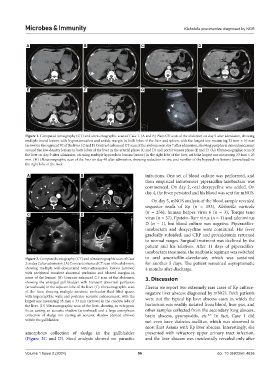
            Figure 1. Computed tomography (CT) and ultrasonographic scan of Case 1. (A and B) Plain CT scan of the abdomen on day 5 after admission, showing
            multiple round lesions with hypoattenuation and untidy margin in both lobes of the liver and spleen, with the largest one measuring 32 mm × 16 mm
            (arrow) in the segment VI of the liver. (C and F) Contrast enhanced CT scan of the abdomen on day 7 after admission, showing peripheral rim enhancement
            around the low-density lesions in both lobes of the liver in the arterial phase (C and D) and portal venous phase (E and F). (G) Ultrasonographic scan of
            the liver on day 9 after admission, showing multiple hypoechoic lesions (arrow) in the right lobe of the liver, with the largest one measuring 33 mm × 25
            mm. (H) Ultrasonographic scan of the liver on day 48 after admission, showing reduction in size and number of the hypoechoic lesions (arrowhead) in
            the right lobe of the liver.

             A                     B                           infections. One set of blood culture was performed, and
                                                               then empirical intravenous piperacillin-tazobactam was
                                                               commenced. On day 2, oral doxycycline was added. On
                                                               day 4, the fever persisted and his blood was sent for mNGS.
                                                                 On day 5, mNGS analysis of the blood sample revealed
                                                               sequence reads of Kp (n = 153),  Klebsiella variicola
                                                               (n =  256), human herpes  virus 6 (n =  3), Torque  teno
             C                     D
                                                               virus (n = 37), Epstein–Barr virus (n = 1) and adenovirus
                                                               D (n  = 1), but blood culture was negative. Piperacillin-
                                                               tazobactam and doxycycline were continued. His fever
                                                               gradually subsided, and CRP and procalcitonin returned
                                                               to normal ranges. Surgical treatment was declined by the
                                                               patient and his relatives. After 11  days of piperacillin-
                                                               tazobactam treatment, the antibiotic regimen was switched
            Figure 2. Computed tomography (CT) and ultrasonographic scan of Case   to oral amoxicillin-clavulanate, which was sustained
            2 on day 2 after admission. (A) Contrast enhanced CT scan of the abdomen,   for  another  5  days.  The  patient  remained  asymptomatic
            showing multiple well-demarcated water-attenuation lesions (arrows)   4 months after discharge.
            with peripheral transient abnormal perfusion and blurred margins in
            some of the lesions. (B) Contrast enhanced CT scan of the abdomen,   3. Discussion
            showing the enlarged gall bladder with transient abnormal perfusion
            (arrowheads) in the adjacent lobe of the liver. (C) Ultrasonographic scan   Herein we report two extremely rare cases of Kp culture-
            of the liver, showing multiple anechoic unilocular fluid-filled spaces   negative liver abscess diagnosed by mNGS. Both patients
            with imperceptible walls and posterior acoustic enhancement, with the   were not the typical Kp liver abscess cases in which the
            largest one measuring 35 mm × 33 mm (arrows) in the caudate lobe of
            the liver. (D) Ultrasonographic scan of the liver, showing an echogenic   bacterium was readily isolated from blood, liver pus, and
            focus  casting  an  acoustic  shadow  (arrowhead)  and  a  large  amorphous   other samples collected from the secondary lung abscess,
            collection of sludge not casting an acoustic shadow (dotted arrows)   brain abscess, pyomyositis,  etc.  In fact, Case 1 did
                                                                                         3-5
            within the gallbladder.                            not even have diabetes mellitus, which was observed in
                                                               most East Asians with Kp liver abscess. Interestingly, she
            amorphous  collection of  sludge in  the  gallbladder   presented with refractory upper urinary tract infection,
            (Figure  2C and  D). Stool analysis showed no parasitic   and the liver abscess was incidentally revealed only after


            Volume 1 Issue 2 (2024)                         96                               doi: 10.36922/mi.4636

