


Page 103 - MI-1-2
P. 103
Microbes & Immunity                                                Klebsiella pneumoniae diagnosed by NGS


            Table 1. Klebsiella pneumoniae liver abscess diagnosed by mNGS
            Case  Reference  Sex/Age Diabetes  Clinical presentation  Bacterial culture  mNGS        Outcome
            no.                 mellitus                Specimen  Result  Specimen  Microbe (no. of reads)
            1    Present   F/60  No    Incidentally discovered   Blood   Negative   Blood   Klebsiella pneumoniae (144) Survived
                 report                during investigation
                                       of upper urinary tract
                                       infection
            2    Present   M/82  Yes   Fever, right upper   Blood  Negative  Blood  Klebsiella pneumoniae   Survived
                 report                quadrant pain                               (153), Klebsiella variicola
                                                                                   (256), HHV-6 (3), Torque
                                                                                   teno virus (37), EBV (1),
                                                                                   adenovirus D (1)
            3    Zeng et al.  F/59  Yes  Discovered during the   CSF  Negative  CSF  Klebsiella pneumoniae   Survived
                 (2021) 14             investigation of acute                      (13470)
                                       meningitis       Blood     Negative  Blood  Klebsiella pneumoniae
                                                        Liver pus  Negative        (5318)
            4    Xie and   F/56  Yes   Fever, pain on percussion  Drain fluid  Positive  Drain fluid Klebsiella pneumoniae   Survived
                 Zhu                   of the abdomen                              (119331)
                 (2021) 15
            5    Luo et al.   M/71  Yes  Incidentally discovered   Blood  Positive  BAL  Klebsiella pneumoniae    Died
                 (2023) 16             during investigation of   Liver pus  Positive  (not mentioned)
                                       subacute pneumonia
                                       syndrome
            Abbreviation: BAL: Bronchoalveolar lavage fluid; CSF: Cerebrospinal fluid; EBV: Epstein–Barr virus; F: Female; HHV: Human herpes virus; M: Male;
            mNGS: Metagenomic next-generation sequencing.

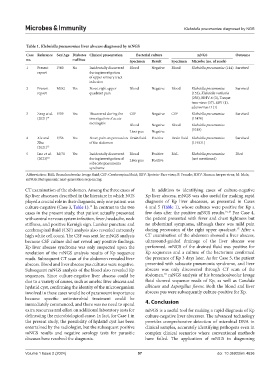
            CT examination of the abdomen. Among the three cases of   In addition to identifying cases of culture-negative
            Kp liver abscesses described in the literature in which NGS   Kp liver abscess, mNGS was also useful for making rapid
            played a crucial role in their diagnosis, only one patient was   diagnosis of Kp liver abscesses, as presented in Cases
                                       14
            culture-negative (Case 3, Table 1).  In contrast to the two   4 and 5 (Table 1), whose cultures were positive for Kp a
            cases in the present study, that patient actually presented   few days after the positive mNGS results. 15,16  For Case 4,
            with central nervous system infection, fever, headache, neck   the patient presented with fever and chest tightness but
            stiffness, and positive Kernig’s sign. Lumbar puncture and   no abdominal symptoms, although there was mild pain
                                                                                                      15
            cerebrospinal fluid (CSF) analysis also revealed extremely   during percussion of the right upper quadrant.  After a
            high white cell count. The CSF was sent for mNGS analysis   CT examination of the abdomen showed a liver abscess,
            because CSF culture did not reveal any positive findings.   ultrasound-guided  drainage  of the  liver  abscess  was
            Kp liver abscess syndrome was only suspected upon the   performed. mNGS of the drained fluid was positive for
            revelation of the mNGS analysis results of Kp sequence   Kp sequences and a culture of the bacterium confirmed
            reads. Subsequent CT scan of the abdomen revealed liver   the presence of Kp 3 days later. As for Case 5, the patient
            abscess. Blood and liver abscess pus cultures were negative.   presented with subacute pneumonia syndrome, and liver
            Subsequent mNGS analysis of the blood also revealed Kp   abscess was only discovered through CT scan of the
                                                                       16
            sequences. Since culture-negative  liver  abscess  could be   abdomen.  mNGS analysis of his bronchoalveolar lavage
            due to a variety of causes, such as amebic liver abscess and   fluid showed sequence reads of Kp, as well as  Candida
            hydatid cyst, confirming the identity of the microorganism   albicans and Aspergillus flavus. Both the blood and liver
            involved in these cases would be of paramount importance   abscess pus were subsequently culture-positive for Kp.
            because specific antimicrobial treatment could be
            immediately commenced, and there was no need to spend   4. Conclusion
            extra resources and effort on additional laboratory tests for   mNGS is a useful tool for making a rapid diagnosis of Kp
            delineating the microbiological cause. In fact, for Case 1 in   culture-negative liver abscesses. The advanced technology
            the present study, the possibility of hydatid cyst has been   provides comprehensive detection of microbial DNA in
            entertained by the radiologist, but the subsequent positive   clinical samples, accurately identifying pathogens even in
            mNGS results and negative serology tests for parasitic   complex clinical scenarios where conventional methods
            diseases have resolved the diagnosis.              have failed. The application of mNGS in diagnosing


            Volume 1 Issue 2 (2024)                         97                               doi: 10.36922/mi.4636

