


Page 91 - MI-2-1
P. 91
Microbes & Immunity                                  Hyphaene thebaica honey as a multitarget therapeutic product


            Manuka honey. Despite this, there are only a few studies
            exploring the bioactive potential of traditional Palestinian
            honey. 31,32,47,52

            3.2. Effects of DH on NO levels
            NO, a  transient bioactive  free  radical,  functions as  a
            signaling  molecule  in  numerous  physiological  and
            pathological processes. The overproduction of NO serves
            as an indicator of the severity and stage of both acute
                                   56
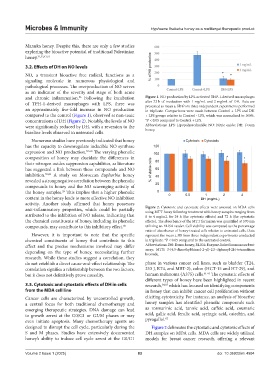
            and chronic inflammation.  Following the incubation   Figure 1. NO production by LPS-activated THP-1-derived macrophages
            of  TPH-1-derived macrophages  with  LPS,  there  was   after 72 h of incubation with 1 mg/mL and 2 mg/mL of DH. Data are
                                                               presented as mean ± SD from three independent experiments performed
            an approximately five-fold increase in NO production   in triplicate. Comparisons were made between Control + LPS and DH
            compared to the control (Figure 1), observed at non-toxic   + LPS groups relative to Control - LPS, which was normalized to 100%.
            concentrations of DH (Figure 2). Notably, the levels of NO   *P < 0.05 compared to Control + LPS.
            were significantly reduced by DH, with a reversion to the   Abbreviations: LPS: Lipopolysaccharide; NO: Nitric oxide; DH: Doum
                                                               honey.
            baseline levels observed in untreated cells.
              Numerous studies have previously indicated that honey             Cytotoxic  Cytostatic
            has the capacity to downregulate inducible NO synthase   120
            expression and NO production. 57-60  The varying phenolic   100
            composition of honey may elucidate the differences in
            their nitrogen oxides suppression capabilities, as literature   80
            has suggested a link between these compounds and NO   % of viable cells    60
            inhibition. 59,60  A study on Moroccan  Euphorbia honey   40
            revealed a strong negative correlation between the phenolic
            compounds in honey and the NO scavenging activity of   20
            the honey samples.  This implies that a higher phenolic   0  0      0.5     1       2       4
                           59
            content in the honey leads to more effective NO inhibition                DH (mg/mL)
            activity. Another  study  affirmed  that  honey possesses
            anti-inflammatory properties, which could be partially   Figure 2. Cytotoxic and cytostatic effects were assessed on MDA cells
                                                               using MTT Assay following treatment with honey samples ranging from
            attributed to the inhibition of NO release, indicating that   0 to 4  mg/mL for 24  h (for cytotoxic effects) and 72  h (for cytostatic
            the chemical constituents of honey, including its phenolic   effects). The absorbance of the MTT formazan was quantified at 570 nm
            compounds, may contribute to this inhibitory effect. 60  utilizing an ELISA reader. Cell viability was computed as the percentage
                                                               ratio of absorbance of honey-treated cells relative to untreated cells. Data
              However, it is important to note that the specific   represent the mean ± SD from three independent experiments conducted
            chemical constituents of honey that contribute to this   in triplicate. *P < 0.05 compared to the untreated control.
            effect and the precise mechanisms involved may differ   Abbreviations: DH: Doum honey; ELISA: Enzyme-linked immunosorbent
            depending on the type of honey, necessitating further   assay; MTT: 3-(4,5-dimethylthiazol-2-yl)-2,5-diphenyl-2H-tetrazolium
                                                               bromide.
            research. While these studies suggest a correlation, they
            do not establish a direct cause-and-effect relationship. The   phase in various cancer cell lines, such as bladder (T24,
            correlation signifies a relationship between the two factors,   253 J, RT4, and MBT-2), colon (HCT-15 and HT-29), and
            but it does not definitively prove causality.      human melanoma (A375) cells. 61-63  The cytostatic effects of
                                                               different types of honey have been highlighted in recent
            3.3. Cytotoxic and cytostatic effects of DH in cells   research, 64,65  which has focused on identifying components
            from the MDA cell line                             in honey that can inhibit cancer cell proliferation without
            Cancer cells are characterized by uncontrolled growth,   eliciting cytotoxicity. For instance, an analysis of bioactive
            a  central  focus  for  both  traditional  chemotherapy  and   honey samples has identified phenolic compounds such
            emerging therapeutic strategies. DNA damage can lead   as rosmarinic acid, tannic acid, caffeic acid, coumaric
            to  growth  arrest  at  the  G0/G1  or  G2/M phases  or  may   acid, gallic acid, ferulic acid, syringic acid, catechin, and
            even initiate apoptosis. Many chemotherapy agents are   pyrogallol. 62
            designed to disrupt the cell cycle, particularly during the   Figure 2 delineates the cytostatic and cytotoxic effects of
            S and M phases. Studies have extensively documented   DH samples on MDA cells. MDA cells are widely utilized
            honey’s ability to induce cell cycle arrest at the G0/G1   models for breast cancer research, offering a relevant


            Volume 2 Issue 1 (2025)                         83                               doi: 10.36922/mi.4994

