


Page 92 - MI-2-1
P. 92
Microbes & Immunity                                  Hyphaene thebaica honey as a multitarget therapeutic product


            platform to evaluate potential therapeutic interventions.
            They exhibit characteristics similar to those of aggressive
            breast cancer phenotypes. Notably, no cytotoxic effects
            were observed across all tested concentrations. DH
            exhibited a modest yet  significant cytostatic activity
            on MDA cells. The most pronounced cytostatic effects
            were noted at concentrations of 4 mg/mL and 2 mg/mL,
            leading to a reduction in cell viability by 25% and 20%,
            respectively, compared to untreated control cells. These
            findings  are consistent  with prior studies,  underscoring
            that the influence of honey can vary based on its type. 65-68
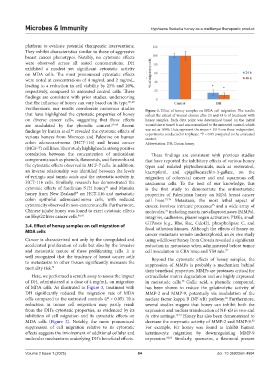
            Furthermore, our results corroborate numerous studies   Figure 3. Effect of honey samples on MDA cell migration. The results
            that have highlighted the cytostatic properties of honey   reflect the extent of wound closure after 24 and 48 h of treatment with
            on diverse cancer cells, suggesting that these effects   honey samples. Each data point was determined based on the initial
            are  modulated  by the  phenolic  content. 65-68  Recent   wound size at time 0 h and was normalized to the untreated control, which
            findings by Imtara et al.  revealed the cytotoxic effects of   was set as 100%. Data represent the mean ± SD from three independent
                               66
            various honeys from Morocco and Palestine on human   experiments conducted in triplicate. *P < 0.05 compared to the untreated
                                                               control.
            colon adenocarcinoma (HCT-116) and breast cancer   Abbreviation: DH: Doum honey.
            (MCF-7) cell lines. Their study highlighted a strong positive
            correlation  between  the  concentration  of  antioxidant   These findings are consistent with previous studies
            components such as phenols, flavonoids, and flavonols and   that have reported the inhibitory effects of various honey
            the cytostatic effects observed in MCF-7 cells. In addition,   types and isolated phytochemicals, such as resveratrol,
            an inverse relationship was identified between the levels   kaempferol, and epigallocatechin-3-gallate, on the
            of syringic and tannic acids and the cytostatic activity in   migration of colorectal cancer and oral squamous cell
            HCT-116  cells. Similarly, research has demonstrated the   carcinoma cells. To the best of our knowledge, this
            cytotoxic effects of Sardinian STH honey  and Manuka   is  the  first  study  to  demonstrate  the  antimetastatic
                                              51
            honey from New Zealand  on HCT-116 and metastatic   properties of Palestinian honey on MDA breast cancer
                                 69
            colon epithelial adenocarcinoma cells, with reduced   cell  lines. 72-74   Metastasis,  the  most  lethal  aspect  of
            cytotoxicity observed in non-cancerous cells. Furthermore,   cancer, involves intricate processes  and a wide array of
                                                                                           75
            Chinese jujube honey was found to exert cytotoxic effects   molecules,  including matrix metalloproteinases (MMPs),
                                                                       76
            on HepG2 liver cancer cells. 69,70                 integrins, cadherins, plasminogen activators, PI3Ks, small
                                                               GTPases  (e.g.,  Rho,  Rac,  Cdc42),  phospholipase  C,  and
            3.4. Effect of honey samples on cell migration of   focal adhesion kinases. Although the effects of honey on
            MDA cells
                                                               cancer metastasis remain underexplored, an in vivo study
            Cancer is characterized not only by the unregulated and   using wildflower honey from Croatia revealed a significant
            accelerated proliferation of cells but also by the invasive   reduction in metastasis when administered before tumor
            and metastatic nature of these proliferating cells. It is   cell inoculation in CBA mice and Y59 rats. 77
            well recognized that the tendency of breast cancer cells   Beyond the cytostatic effects of honey samples, the
            to metastasize to other tissues significantly increases the   suppression of MMPs is probably a mechanism behind
            mortality risk. 71
                                                               their beneficial properties. MMPs are proteases critical for
              Here, we performed a scratch assay to assess the impact   extracellular matrix degradation and are highly expressed
            of DH, administered at a dose of 4 mg/mL, on migration   in metastatic cells.  Gallic acid, a phenolic compound,
                                                                              78
            of MDA cells. As illustrated in Figure 3, treatment with   has been shown to reduce the gelatinolytic activity of
            DH significantly reduced the migration rate of MDA   MMP-2  and  MMP-9,  potentially  via  modulation  of  the
            cells compared to the untreated controls (P < 0.05). This   nuclear factor kappa B (NF-κB) pathway.  Furthermore,
                                                                                                 63
            reduction  in  tumor  cell  migration  may  partly  result   several studies suggest that honey can inhibit both the
            from the DH’s cytostatic properties, as evidenced by its   expression and nuclear translocation of NF-κB in vivo and
            inhibition of cell migration and its cytostatic effects on   in vitro settings. 79-81  Honey has also been demonstrated to
            MDA cells (Figure  2). Notably, the more pronounced   decrease the enzymatic activity of MMP-2 and MMP-9.
                                                                                                            82
            suppression of cell migration relative to its cytostatic   For example, Fir honey was found to inhibit human
            effects suggests the involvement of additional cellular and   keratinocyte migration by downregulating MMP-9
            molecular mechanisms underlying DH’s beneficial effects.  expression. 82,83  Similarly, quercetin, a flavonoid present


            Volume 2 Issue 1 (2025)                         84                               doi: 10.36922/mi.4994

