


Page 93 - MI-2-1
P. 93
Microbes & Immunity                                  Hyphaene thebaica honey as a multitarget therapeutic product


            in honey, has been reported to suppress the expression of   include the inhibition of angiogenesis and metastasis, anti-
            MMP-2 and MMP-9 in PC3 prostate cancer cells. 84,85  proliferative effects, anti-inflammatory action, and the
                                                               promotion of apoptosis. Recently, a wide range of novel
            3.5. Total polyphenols, flavonoids, and antioxidant   polyphenolic compounds with potential anticancer activity
            capacity                                           have been identified globally. Some of these compounds
            Honey serves as a robust source of natural antioxidants,   show promise as anticancer agents, capable of treating or
            which play a crucial role in protecting against the effects   preventing cancer growth by targeting various stages of
            of oxidizing agents on both food preservation and human   cancer development, such as initiation, promotion, and
            health. It contributes to the reduction of health risks such   progression. 89
            as heart disease and cancer and prevents the deterioration   We employed HPLC analysis to isolate phenolic
            of the immune system, cataracts, and various inflammatory   compounds  with  potential  anticancer  properties  from
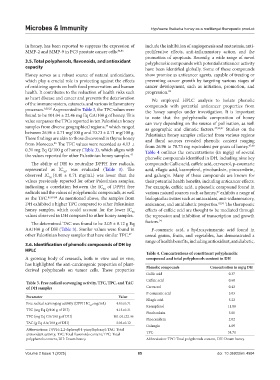
            processes. 8,20,25  As presented in Table 3, the TPC values were   the honey samples under investigation. It is important
            found to be 101.04 ± 22.46 mg Eq GA/100 g of honey. This   to note that the polyphenolic composition of honey
            value surpasses the TPCs reported in ten Palestinian honey   can vary depending on the source of pollination, as well
            samples from diverse geographical regions,  which ranged   as geographic and climatic factors. 47,90,91  Studies on the
                                              47
            between 26.96 ± 0.71 mg/100 g and 70.73 ± 0.71 mg/100 g.   Palestinian honey samples collected from various regions
            These findings are akin to those discovered in thyme honey   and floral sources revealed phenolic content ranging
            from Morocco.  The TFC values were recorded as 4.13 ±   from 26.96 to 70.73 mg equivalent per gram of honey. 47,66
                        86
            0.31 mg Eq Q/100 g of honey (Table 3), which aligns with   Table 4  outlines the concentrations (in mg/g) of several
            the values reported for other Palestinian honey samples. 47  phenolic compounds identified in DH, including nine key
              The ability of DH to neutralize DPPH free radicals,   compounds: Gallic acid, caffeic acid, carvacrol, p-coumaric
            represented as IC , was evaluated (Table 3). The   acid, ellagic acid, kaempferol, pinobanksin, pinocembrin,
                            50
            observed IC (4.40 ± 0.71  mg/mL) was lower than the   and galangin. Many of these compounds are known for
                      50
            values previously reported for other Palestinian samples,   their potential health benefits, including anticancer effects.
            indicating a correlation between the IC  of DPPH free   For example, caffeic acid, a phenolic compound found in
                                             50
            radicals and the values of polyphenolic compounds, as well   various natural sources such as honey,  exhibits a range of
                                                                                             47
            as the TFC. 47,87,88  As mentioned above, the samples from   biological activities such as antioxidant, anti-inflammatory,
            DH exhibited a higher TPC compared to other Palestinian   anticancer, and antidiabetic properties. 92,93  The therapeutic
            honey samples, which could account for the lower IC    effects of caffeic acid are thought to be mediated through
                                                         50
            values observed in DH compared to other honey samples.  the repression and inhibition of transcription and growth
              The determined TAC was found to be 3.05 ± 0.12 g Eq   factors. 94
            AA/100 g of DH (Table 3). Similar values were found in   P-coumaric acid, a hydroxycinnamic acid found in
            other Palestinian honey samples that have similar TPC. 47  cereal grains, fruits, and vegetables, has demonstrated a
                                                               range of health benefits, including antioxidant, antidiabetic,
            3.6. Identification of phenolic compounds of DH by
            HPLC
                                                               Table 4. Concentrations of constituent polyphenolic
            A growing body of research, both  in vitro and  in vivo,   compound and total polyphenols content in DH
            has highlighted the anti-carcinogenic properties of plant-  Phenolic compounds  Concentration in mg/g DH
            derived polyphenols on tumor cells. These properties
                                                               Gallic acid                        0.37
                                                               Caffeic acid                       0.68
            Table 3. Free radical scavenging activity, TFC, TPC, and TAC
            of DH samples                                      Carvacrol                          0.42
                                                               P-coumaric acid                    5.03
            Parameter                              Value
                                                               Ellagic acid                       5.22
            Free radical scavenging activity (DPPH IC ; mg/mL)  4.40±0.71
                                       50                      Kaempferol                         11.88
            TFC (mg Eq Q/100 g of DH)             4.13±0.31
                                                               Pinobanksin                        5.00
            TPC (mg Eq GA/100 g of DH)           101.04±22.46
                                                               Pinocembrin                        2.02
            TAC (g Eq AA/100 g of DH)             3.05±0.12
                                                               Galangin                           4.09
            Abbreviations: DPPH: 2,2-diphenyl-1-picrylhydrazyl; TAC: Total
            antioxidant activity; TFC: Total flavonoids content; TPC: Total   TPC                 34.71
            polyphenols content, DH: Doum honey.               Abbreviation: TPC: Total polyphenols content, DH: Doum honey.

            Volume 2 Issue 1 (2025)                         85                               doi: 10.36922/mi.4994

