


Page 56 - MI-2-3
P. 56
Microbes & Immunity                                       Understanding lung development, health, and diseases


              According to the prevailing historical theory, the lung
            originated as an aquatic organ that resembles a swim
            bladder.  Due to the presence of epithelial cells lining the
                  2
            swim bladder that contains surfactant proteins, lipids,
            and lamellar bodies – organelles that transport surfactant
            to the cell surface – sonic hedgehog expression in the
            endoderm is essential for swim bladder development in
            zebrafish. It is also known that the development of the
            heart’s inflow and outflow tracts is regulated by signals
            from the pulmonary and pharyngeal endoderm. This
            implies that the cardiovascular system and lungs may have
            coevolved. 3
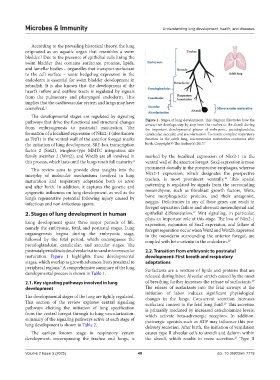
              The developmental stages are regulated by signaling
            pathways that drive the functional and structural changes   Figure 1. Stages of lung development. This diagram illustrates how the
                                                               airway tree develops step-by-step from the trachea to the alveoli during
            from embryogenesis to postnatal maturation. The    the  important  developmental phases  of embryonic,  pseudoglandular,
            formation of a localized expression of Nkx2-1 (also known   canalicular, saccular, and alveolarization. To ensure complete respiratory
            as Titf1) in the ventral wall of the anterior foregut marks   function in the adult lung, microvascular maturation continues after
            the initiation of lung development. SRY-box transcription   birth. Copyright © The Author(s) 2017. 5
            factor  2 (Sox2),  wingless-type  MMTC integration  site
            family member 2 (Wnt2), and Wnt2b are all involved in   marked by the localized expression of Nkx2-1 in the
            this process, which lasts until the lungs reach full maturity. 4  ventral wall of the anterior foregut. Sox2 expression is most
              This review aims to provide clear insights into the   prominent dorsally in the prospective esophagus, whereas
            interplay of molecular mechanisms involved in lung   Nkx2-1  expression,  which  designates  the  prospective
                                                                                                16
            maturation and respiratory adaptation both  in  utero   trachea, is most prominent ventrally.  This spatial
            and after birth. In addition, it captures the genetic and   patterning is regulated by signals from the surrounding
            epigenetic influences on lung development, as well as the   mesenchyme, such as fibroblast growth factors, Wnts,
            lung’s regenerative potential following injury caused by   bone morphogenetic proteins, and their antagonist,
            infectious and non-infectious agents.              noggin. Deficiencies in any of these genes can result in
                                                               foregut separation failure and aberrant mesenchymal and
            2. Stages of lung development in human             epithelial differentiation.  Wnt signaling, in particular,
                                                                                   17
                                                               plays an important role at this stage. The loss of Nkx2-1
            Lung  development  spans  three  major  periods  of  life,   expression, expansion of Sox2 expression, and failure of
            namely the embryonic, fetal, and postnatal stages. Lung   foregut separation occur when Wnt2 and Wnt2b, expressed
            organogenesis begins during the embryonic stage,   in the mesoderm surrounding the anterior foregut, are
            followed by the fetal period, which encompasses the   coupled with beta-catenin in the endoderm. 18
            pseudoglandular, canalicular, and saccular stages. The
            postnatal period includes alveolarization and microvascular   2.2. Transition from embryonic to postnatal
            maturation.  Figure  1 highlights these developmental   development: First breath and respiratory
            stages, which overlap as growth advances from proximal to   adaptations
            peripheral regions.  A comprehensive summary of the lung   Surfactants are a mixture of lipids and proteins that are
                           5
            developmental process is shown in Table 1.
                                                               released during labor. Alveolar stretch caused by the onset
                                                                                                            19
            2.1. Key signaling pathways involved in lung       of breathing further increases the release of surfactants.
            development                                        The release of surfactants into the fetal airways at the
                                                               initiation of labor induces significant physiological
            The developmental stages of the lung are tightly regulated.   changes in the lungs. Concurrent secretion increases
            This section of the review explores central signaling   surfactant content in the fetal lung fluid.  This secretion
                                                                                                20
            pathways eliciting the initiation of lung specification   is primarily mediated by increased catecholamine levels,
            from the ventral foregut through to lung vascularization.   which activate beta-adrenergic receptors. In addition,
            summary of the signaling pathways active at each stage of   purinergic agonists such as ATP may influence this pre-
            lung development is shown in Table 2.              delivery secretion. After birth, the initiation of ventilation
              The  earliest  known  stage  in respiratory  system   causes type II alveolar cells to stretch and deform within
            development, encompassing the trachea and lungs, is   the alveoli, which results in more secretion.  Type  II
                                                                                                     21

            Volume 2 Issue 3 (2025)                         48                               doi: 10.36922/mi.7719

