


Page 57 - MI-2-3
P. 57
Microbes & Immunity                                       Understanding lung development, health, and diseases


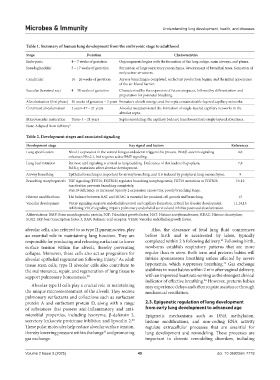
            Table 1. Summary of human lung development from the embryonic stage to adulthood
            Stage                     Duration                             Characteristics
            Embryonic          4 – 7 weeks of gestation  Organogenesis begins with the formation of the lung anlage, main airways, and pleura.
            Pseudoglandular    5 – 17 weeks of gestation  Formation of large respiratory parenchyma, development of bronchial trees, formation of
                                                    early acinar structures.
            Canalicular        16 – 26 weeks of gestation  Airway branching is completed, surfactant production begins, and the initial appearance
                                                    of the air-blood barrier.
            Saccular (terminal sac)  4 – 38 weeks of gestation  Characterized by the expansion of future airspaces, followed by differentiation and
                                                    preparation for postnatal breathing.
            Alveolarization (first phase) 36 weeks of gestation – 3 years Immature alveoli emerge, and the septa contain double-layered capillary networks.
            Continued alveolarization  2 years–17 – 21 years  Alveolar maturation and the formation of single-layered capillary networks in the
                                                    alveolar septa.
            Microvascular maturation  Term–3 – 21 years  Septa remodeling: the capillary beds are transformed into single-layered structures.
            Note: Adapted from Schittny 5

            Table 2. Development stages and associated signaling
            Development stage                           Key signal and factors                     References
            Lung specification  Nkx2.1 expression in the ventral foregut endoderm triggers this process. Wnt/β-catenin signaling   4,6
                              enhances Nkx2.1, but requires active BMP signaling.
            Lung bud initiation  Retinoic acid signaling is critical to lung budding. Deficiency of this leads to hypoplasia.  7,8
                              RAR-γ mutations affect alveolar development.
            Airway branching  Epithelial branching is important for airway branching, and it is induced by peripheral lung mesenchyme.  9
            Branching morphogenesis FGF signaling (FGF10, FGFR2b) regulates branching morphogenesis; FGF10 mutations or FGFR2b   10-12
                              inactivation prevents branching completely.
                              FGF10 deficiency or increased Sprouty 2 expression causes tiny, poorly branching lungs.
            Histone modifications  The balance between HAT and HDAC is essential for proximal cell growth and branching.  13
            Vascular development  VEGF signaling supports endothelial survival and capillary formation, critical for alveolar development.   11,14,15
                              Inhibiting VEGF signaling impairs pulmonary endothelial survival and inhibits postnatal alveolarization.
            Abbreviations: BMP: Bone morphogenetic protein; FGF: Fibroblast growth factor; HAT: Histone acetyltransferases; HDAC: Histone deacetylase;
            SOX2: SRY-box transcription factor 2; RAR: Retinoic acid receptor; VEGF; Vascular endothelial growth factor.
            alveolar cells, also referred to as type II pneumocytes, play   Also, the clearance of fetal lung fluid commences
            an essential role in maintaining lung function. They are   before birth and is accelerated by labor, typically
            responsible for producing and releasing surfactant to lower   completed within 2 h following delivery.  Following birth,
                                                                                               24
            surface tension within the alveoli, thereby preventing   newborns establish respiratory patterns that are more
            collapse. Moreover, these cells also act as progenitors for   regular than in utero. Both term and preterm babies will
            alveolar epithelial regeneration following injury.  As adult   initiate spontaneous breathing  unless  affected  by severe
                                                  3
                                                                                                25
            tissue stem cells, type II alveolar cells also contribute to   hypoxemia, which suppresses breathing.  Gas exchange
            the maintenance, repair, and regeneration of lung tissue to   stabilizes in most babies within 2 min after vaginal delivery,
            support pulmonary homeostasis. 22                  with an improved heart rate serving as the strongest clinical
                                                                                        26
                                                               indicator of effective breathing.  However, preterm babies
              Alveolar type II cells play a crucial role in maintaining   may experience delays and often require assistance through
            the unique microenvironment of the alveoli. They secrete   mechanical ventilation.
            pulmonary surfactants and collections such as surfactant
            protein A and surfactant protein D, along with a range   2.3. Epigenetic regulation of lung development
            of substances that possess anti-inflammatory and anti-  from early lung development to advanced age
            microbial  properties,  including  lysozyme,  β-defensin  2,   Epigenetic mechanisms such as DNA methylation,
            secretory leukocyte proteinase inhibitor, and lipocalin 2.    histone  modifications,  and  non-coding  RNA  activity
                                                         20
            These polar molecules help reduce alveolar surface tension,   regulate extracellular processes that are essential for
            thereby lowering pressure within the lungs  and promoting   lung development and remodeling. These processes are
                                             23
            gas exchange.                                      important  in  chronic  remodeling  disorders,  including

            Volume 2 Issue 3 (2025)                         49                               doi: 10.36922/mi.7719

