


Page 59 - MI-2-3
P. 59
Microbes & Immunity                                       Understanding lung development, health, and diseases


            both a diagnostic and potentially therapeutic technique.   Human-induced pluripotent stem cells (iPSCs) can be
            Nonetheless, surgical excision remains the established   differentiated into key lung epithelial cell types such as
            treatment, offering symptomatic relief and enabling   alveolar type I and II cells, basal cells, and airway secretory
            conclusive diagnosis through pathological testing. 43  cells, which are required for lung function and barrier
                                                               integrity.  Figure  3  depicts  a  proposed  pathway  for  the
            3.4. CLE                                           differentiation of proximal and distal epithelial lineages
            CLE is a rare developmental lung disorder marked by   in the lung after activation of human iPSC-derived airway
            hyperinflation of one or more lung lobes. This compresses   epithelium through Wnt signaling.
            the surrounding lung tissue, potentially causing respiratory   4.1. Infectious injury
            complications. In severe conditions, surgical removal of
            the hyperinflated lobe may be required.  CLE develops   The  COVID-19  pandemic  has  emphasized  the negative
                                             44
                                                                                                            50
            during lung development, with parenchymal deformities   impact of infectious injuries on the respiratory system.
            possibly resulting from abnormalities occurring as early as   Infectious diseases that affect the lungs can cause
            the 3  week of gestation when the respiratory system starts   cellular damage, resulting in increased permeability and
                rd
            to mature. Alternative terms for CLE include congenital   susceptibility to secondary infections. While the lungs
            lobar overinflation, congenital big hyperlucent lobe, and   remain quiescent during homeostasis, infections such as
            congenital alveolar overdistension.  Approximately half
                                        45
            of affected patients experience symptoms within the first   A     B                C
            6  months  of  life, with  nearly 50%  exhibiting  symptoms
            at birth. Overinflation of the affected lobe results in
            compromised perfusion and ventilation. As overinflation
            worsens, compression of adjacent organs and lung tissue
            further impairs ventilation and perfusion in these regions,
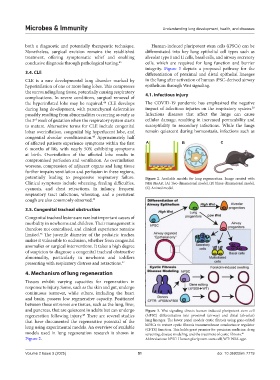
            potentially leading to progressive respiratory failure.   Figure  2. Available models for lung regeneration. Image created with
            Clinical symptoms include wheezing, feeding difficulties,   NIH BioArt. (A) Two-dimensional model, (B) Three-dimensional model,
            cyanosis, and chest retractions. In infancy, frequent   (C) Animal model.
            respiratory tract infections, wheezing, and a persistent
            cough are also commonly observed. 44

            3.5. Congenital tracheal obstruction
            Congenital tracheal lesions are rare but important causes of
            morbidity in newborns and children. Their management is
            therefore not centralized, and clinical experience remains
            limited.   The juvenile  diameter  of  the  pediatric  trachea
                  46
            makes it vulnerable to occlusion, whether from congenital
            anomalies or surgical interventions. It takes a high degree
            of suspicion to diagnose a congenital tracheal obstructive
            abnormality, particularly in newborns and toddlers
            presenting with respiratory distress and retractions. 47

            4. Mechanism of lung regeneration
            Tissues exhibit varying capacities for regeneration in
            response to injury. Some, such as the skin and gut, undergo
            continuous turnover, while others, including the heart
            and brain, possess low regenerative capacity. Positioned
            between these extremes are tissues, such as the lung, liver,
            and pancreas, that are quiescent in adults but can undergo   Figure  3.  Wnt signaling directs human induced pluripotent stem cell
            regeneration following injury.  There are several studies   (hiPSC) differentiation into proximal (airway) and distal (alveolar)
                                    48
            that have documented the regenerative potential of the   lung lineages. The lower panel models cystic fibrosis using gene-edited
            lung using experimental models. An overview of available   hiPSCs to restore cystic fibrosis transmembrane conductance regulator
                                                               (CFTR) function. This holds great promise for precision medicine, drug
            models used in lung regeneration research is shown in   screening, disease modeling, and the treatment of cystic fibrosis. 49
            Figure 2.                                          Abbreviations: hPSC: Human pluripotent stem cell; WT: Wild-type.


            Volume 2 Issue 3 (2025)                         51                               doi: 10.36922/mi.7719

