


Page 60 - MI-2-3
P. 60
Microbes & Immunity                                       Understanding lung development, health, and diseases


            influenza result in the loss of epithelial cells. This infection
            triggers the activation of many progenitor cells related to a
            particular compartment of the lung. In particular, alveolar
            type 2 cells respond to Wnt signaling and begin to grow
            rapidly during the first 2 – 3 weeks following infection,
                                                        3,51
            contributing to the restoration of alveolar function.
            4.2. Non-infectious injury
            Lung  injury  can  also  be  caused  by  chemicals  such  as
            naphthalene and polidocanol, as well as gases like sulfur
            dioxide. Special pollution-resistant Clara-like epithelial
            (CE) stem cells have been demonstrated to survive in
            the  terminal  bronchioles following naphthalene-induced
            damage  that impairs  the normal progenitor (Clara)
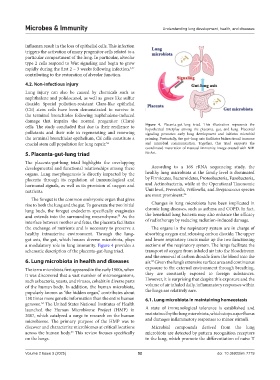
            cells. The study concluded that due to their resilience to   Figure  4. Placenta-gut-lung triad. This illustration represents the
                                                               hypothetical interplay  among the  placenta,  gut,  and  lung.  Placental
            pollutants  and  their  role  in  regenerating  and  renewing   signaling promotes early lung development and initiates microbial
            the terminal bronchiolar epithelium, CE cells constitute a   priming. Postnatally, the gut–lung axis facilitates bidirectional immune
            crucial stem cell population for lung repair. 52   and microbial communication. Together, this triad supports the
                                                               coordinated maturation of mucosal immunity. Image created with NIH
            5. Placenta-gut-lung triad                         BioArt.
            The placenta-gut-lung triad highlights the overlapping
            developmental and functional relationships among these   According  to  a  16S  rRNA  sequencing  study,  the
            organs. Lung morphogenesis is directly impacted by the   healthy lung microbiota at the family level is dominated
            placenta through its regulation of immunological and   by Firmicutes, Bacteroidetes, Proteobacteria, Fusobacteria,
            hormonal signals, as well as its provision of oxygen and   and Actinobacteria, while at the Operational Taxonomic
            nutrients.                                         Unit level, Prevotella, Veillonella, and Streptococcus species
                                                               are most prominent. 56
              The foregut is the common embryonic organ that gives
            rise to both the lung and the gut. To generate the two initial   Changes in lung microbiota have been implicated in
            lung  buds, the  foregut endoderm specifically evaginates   chronic lung diseases, such as asthma and COPD. In fact,
                                                   53
            and extends into the surrounding mesenchyme.  As the   the beneficial lung bacteria may also enhance the efficacy
            interface between mother and fetus, the placenta facilitates   of radiotherapy by reducing radiation-induced damage.
            the exchange of nutrients and is necessary to preserve a   The organs in the respiratory system are in charge of
            healthy intrauterine environment. Through the lung-  absorbing oxygen and releasing carbon dioxide. The upper
            gut axis, the gut, which houses diverse microbiota, plays   and lower respiratory tracts make up the two functioning
            a modulatory role in lung immunity. Figure 4 provides a   sections of the respiratory system. The lungs facilitate the
            schematic description of the placenta-gut-lung triad.  transport of oxygen from inhaled air into the bloodstream
                                                               and the removal of carbon dioxide from the blood into the
            6. Lung microbiota in health and diseases          air.  Given the lung’s extensive surface area and continuous
                                                                 57
            The term microbiota first appeared in the early 1900s, when   exposure to the external environment through breathing,
            it was discovered that a vast number of microorganisms,   they  are constantly exposed  to foreign substances.
            such as bacteria, yeasts, and viruses, cohabit in diverse parts   However, it is surprising that despite this exposure and the
            of the human body. In addition, the human microbiota,   volume of air inhaled daily, inflammatory responses within
            popularly known as “the hidden organ,” contributes about   the lungs are relatively rare.
            150 times more genetic information than the entire human   6.1. Lung microbiota in maintaining homeostasis
                   54
            genome.  The United States National Institutes of Health
            launched the Human Microbiome Project (HMP) in     A state of immunological tolerance  is established and
            2007, which catalyzed a surge in research on the human   maintained by the lung microbiota, which stops superfluous
            microbiome. The  primary purpose  of  the  HMP  was  to   and damages inflammatory responses to minor stimuli.
            discover and characterize microbiomes at critical locations   Microbial compounds derived from the lung
            across the human body.  This review focuses specifically   microbiota are detected by pattern recognition receptors
                               55
            on the lungs.                                      in the lung, which promote the differentiation of naive T

            Volume 2 Issue 3 (2025)                         52                               doi: 10.36922/mi.7719

