


Page 95 - MI-2-4
P. 95
Microbes & Immunity                                         Brachyspira pilosicoli novel outer membrane proteins


            Table 2. (Continued)
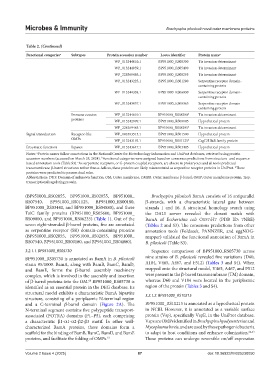
            Functional categories a  Subtypes  Protein accession number  Locus identifier  Protein name a
                                                  WP_013244610.1    BP951000_RS08300  Tia invasion determinant
                                                  WP_013244059.1    BP951000_RS05490  Tia invasion determinant
                                                  WP_228369485.1    BP951000_RS08295  Tia invasion determinant
                                                  WP_013243225.1    BP951000_RS01280  Serpentine receptor domain-
                                                                                     containing protein
                                                  WP_013244338.1    BP951000_RS06930  Serpentine receptor domain-
                                                                                     containing protein
                                                  WP_013243037.1    BP951000_RS00365  Serpentine receptor domain-
                                                                                     containing protein
                               Immune evasion     WP_013244610.1    BP951000_RS08300 d  Tia invasion determinant
                               proteins           WP_013242999.1    BP951000_RS00185  Hypothetical protein
                                                  WP_228369485.1    BP951000_RS08295 d  Tia invasion determinant
            Signal transduction  Receptor-like    WP_181893515.1    BP951000_RS01590  Hypothetical protein
                               OMPs               WP_013243193.1    BP951000_RS01125 d  CsgG/HfaB family protein
            Enzymatic functions  Lipases          WP_013243647.1    BP951000_RS03405  Hypothetical protein
            Notes:  Protein names follow annotations in the National Center for Biotechnology Information and UniProt databases, retrieved using protein
                 a
            accession numbers (accessed on March 28, 2024).  Functional categories were assigned based on consensus predictions from structure- and sequence-
                                            b
            based annotation tools (Table S3). As serpentine receptors, or G-protein coupled receptors, are absent in prokaryotes and all tools predicted
                                   c
            transmembrane β-barrel structures rather than α-helices, these proteins are likely misannotated as serpentine receptor proteins in UniProt.  These
                                                                                                     d
            proteins were predicted to possess dual roles.
            Abbreviations: DUF: Domain of unknown function; OM: Outer membrane; OMBB: Outer membrane β-barrel; OMP: Outer membrane protein; Trep:
            transcriptional regulating protein.
            (BP951000_RS02055,  BP951000_RS02055,  BP951000_     Brachyspira pilosicoli BamA consists of 16 antiparallel
            RS07540,  BP951000_RS01125,   BP951000_RS00180,    β-strands, with a characteristic lateral gate between
            BP951000_RS03440, and BP951000_RS04880), and three   strands 1 and 16. A  structural homology search using
            TolC family proteins (BP951000_RS05600, BP951000_  the  DALI  server  revealed  the  closest  match  with
            RS09000, and BP951000_RS06235) (Table 1). Out of the   BamA of  Escherichia coli O157:H7 (PDB ID: 7NRE)
            seven eight-stranded β-barrel proteins, five are annotated   (Tables 2 and S3). The consensus predictions from other
            as  serpentine  receptor  (SR)  domain-containing  proteins   annotation tools (Foldseek, PANNZER, and eggNOG-
            (BP951000_RS02055,  BP951000_RS02055,  BP951000_   mapper) validated the functional annotation of BamA in
            RS07540, BP951000_RS00180, and BP951000_RS04880).  B. pilosicoli (Table S3).

            3.2.1.1. BP951000_RS05730                            Sequence comparison of BP951000_RS05730 across
            BP951000_RS05730 is annotated as BamA in B. pilosicoli   nine strains of B. pilosicoli revealed five variations (D60,
            strain 95/1000. BamA, along with BamB, BamC, BamD,   A184,  V465, A467,  and  F512) (Tables  3 and S4).  When
            and BamE, forms the  β-barrel assembly machinery   mapped onto the structural model, V465, A467, and F512
            complex, which is involved in the assembly and insertion   were present in the β-barrel transmembrane (TM) domain,
                                       60
            of β-barrel proteins into the OM.  BP951000_RS05730 is   whereas  D60  and V184  were  located in  the  periplasmic
            identified as an essential protein in the DEG database. Its   region of the protein (Tables 3 and S4).
            structural model exhibits a characteristic BamA bipartite   3.2.1.2. BP951000_RS10215
            structure, consisting of a periplasmic N-terminal region
            and a C-terminal  b-barrel domain (Figure  2A). The   BP951000_RS10215 is annotated as a hypothetical protein
            N-terminal segment contains five polypeptide transport-  in NCBI. However, it is annotated as a variable surface
            associated (POTRA) domains (P1–P5), each comprising   protein (Vsp), specifically VspE, in the UniProt database.
            a characteristic  β1-α1-α2-β2-β3 motif. In other well-  Vsps are OMPs identified in Brachyspira hyodysenteriae and
            characterized  BamA proteins,  these domains  form  a   Mycoplasma bovis, and are used by these pathogenic bacteria
            scaffold for the binding of BamB, BamC, BamD, and BamE   to adapt to host conditions and enhance colonization. 62,63
            proteins, and facilitate the folding of OMPs. 61   These proteins can undergo reversible on/off expression


            Volume 2 Issue 4 (2025)                         87                           doi: 10.36922/MI025230050

