


Page 36 - MSAM-1-1
P. 36
Materials Science in Additive Manufacturing                                Cylindrical path planning for AM


            3D CAD models of the parts. For the propeller, only one   slicing approach. The twist lock pins were printed using
            blade is shown as a representative.                our developed WAAM system. WAAM is a subcategory
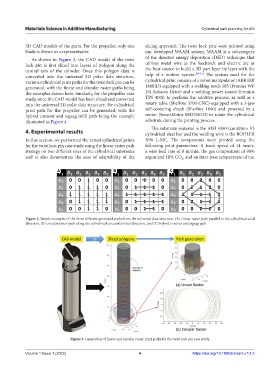
              As shown in  Figure  3, the CAD model of the twist   of the directed energy deposition (DED) technique that
            lock pin is first sliced into layers of polygon along the   utilizes metal wire as the feedstock and electric arc as
            central axis of the cylinder. Once this polygon data is   the heat source to build a 3D part layer by layer with the
                                                                                    [17-19]
            converted  into  the  universal  3D  polar  data  structure,   help of a motion system.   The system used for the
            various cylindrical print paths for the twist lock pin can be   cylindrical print consists of a robot manipulator (ABB IRB
            generated, with the linear and circular raster paths being   1660ID) equipped with a welding torch 165 (Fronius WF
            the examples shown here. Similarly, for the propeller case   25i Robacta Drive) and a welding power source (Fronius
            study, once the CAD model has been sliced and converted   TPS 400i) to perform the additive process, as well as a
            into the universal 3D polar data structure, the cylindrical   rotary table (Sherline 3700-CNC) equipped with a 3-jaw
            print path for the propeller can be generated, with the   self-centering chuck (Sherline 1040) and powered by a
            hybrid contour and zigzag infill path being the example   motor (SmartMotor SM23165D) to rotate the cylindrical
            illustrated in Figure 4.                           substrate during the printing process.
                                                                 The substrate material is the AISI 4340 (condition V)
            4. Experimental results                            cylindrical steel bar and the welding wire is the BOHLER
            In this section, we performed the actual cylindrical prints   X96 L-MC. The components were printed using the
            for the twist lock pin case study using the linear raster path   following print parameters: A  torch speed of 14  mm/s,
            strategy on two different sizes of the cylindrical substrates   a wire feed rate of 8 m/min, the gas composition of 90%
            and to also demonstrate the ease of adaptability of the   argon and 10% CO , and an inter-pass temperature of not
                                                                              2

                         A                       B                       C


            Figure 2. Simple examples of the three different generated paths from the universal data structure: (A) Linear raster path parallel to the cylindrical axial
            direction, (B) circular raster path along the cylindrical circumferential direction, and (C) hybrid contour and zigzag path.


                               Figure 3. Generation of linear and circular raster print paths for the twist lock pin case study.


            Volume 1 Issue 1 (2022)                         4                      https://doi.org/10.18063/msam.v1i1.3

