


Page 56 - MSAM-1-1
P. 56
Materials Science in Additive Manufacturing                      From 3D printed molds to bioprinted scaffolds


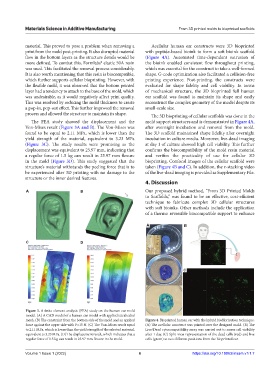
            material. This proved to pose a problem when removing a   Acellular human ear constructs were 3D bioprinted
            print from the mold post-printing. It also disrupted material   with peptide-based bioink to form a soft bioink scaffold
            flow in the bottom layers as the structure details would be   (Figure  4A).  Automated  time-dependent  extrusion  of
            more defined. To combat this, Formlabs® elastic 50A resin   the bioink enabled consistent flow throughout printing,
            was used. This facilitated the removal process considerably.   which was essential for the construct to take a well-formed
            It is also worth mentioning that this resin is biocompatible,   shape. G-code optimization also facilitated a collision-free
            which further supports cellular bioprinting. However, with   printing experience. Post-printing, the constructs were
            the flexible mold, it was observed that the bottom printed   evaluated for shape fidelity and cell viability. In terms
            layer had a tendency to attach to the base of the mold, which   of  mechanical  structure,  the  3D  bioprinted  full  human
            was undesirable, as it would negatively affect print quality.   ear scaffold was found to maintain its shape and easily
            This was resolved by reducing the mold thickness to create   reconstruct the complex geometry of the model despite its
            a pop-in, pop-out effect. This further improved the removal   small-scale size.
            process and allowed the structure to maintain its shape.  The 3D bioprinting of cellular scaffolds was done in the

              The FEA study showed the displacement and the    mold support structures and is demonstrated in Figure 4A,
            Von-Mises result (Figure 3A and B). The Von-Mises was   after overnight incubation and removal from the mold.
            found to be equal to 2.11 MPa, which is lower than the   The 3D scaffold maintained shape fidelity after overnight
            yield strength of the material, equivalent to 3.23 MPa   incubation in culture media. Moreover, live-dead imaging
            (Figure  3C). The study results were promising as the   at day 1 of culture showed high cell viability. This further
            displacement was equivalent to 25.97 mm, indicating that   confirms the biocompatibility of the mold resin material
            a regular force of 1.5 kg can result in 25.97 mm flexure   and verifies the practicality of use for cellular 3D
            in the mold (Figure  3D). This study suggested that the   bioprinting. Confocal images of the cellular scaffold were
            structure’s material withstands the peeling force that is to   taken (Figure 4B and C). In addition, the z-stacking video
            be experienced after 3D printing with no damage to the   of the live-dead imaging is provided as Supplementary File.
            structure or the inner desired features.
                                                               4. Discussion
            A                      B                           Our proposed hybrid method, “From 3D Printed Molds
                                                               to Scaffolds,” was found to be an effective, cost-efficient
                                                               technique to fabricate complex 3D cellular structures
                                                               with soft bioinks. Other methods include the application
                                                               of a thermo reversible biocompatible support to enhance

                                                               A               B


            C                      D


                                                                               C


            Figure 3. A finite element analysis (FEA) study on the human ear mold
            model. (A) A CAD model of a human ear model with applied tetrahedral
            mesh. (B) The constraint from the bottom side of the mold and an applied   Figure 4. Bioprinted human ear with the hybrid biofabrication technique.
            force against the upper side with F=15 N. (C) The Von-Mises result equal   (A) The acellular construct was printed over the designed mold. (B) The
            to 2.11 MPa, which is lower than the yield strength of the selected material,   Live/Dead cytocompatibility assay was carried out to assess cell viability
            equivalent to 3.23 MPa. (D) The displacement result, which indicates that a   after 1 day. (C) Split-view representation of the dead cells (red) and live
            regular force of 1.5 kg can result in 25.97 mm flexure in the mold.  cells (green) at two different positions from the bioprinted ear.


            Volume 1 Issue 1 (2022)                         6                      https://doi.org/10.18063/msam.v1i1.7

