


Page 61 - MSAM-1-1
P. 61
Materials Science in Additive Manufacturing                                  Thixotropic metal 3D printing


            (according to ISO/ASTM 52900 Standard) . In recent   and both are simple compared with beam-based melting/
                                                [2]
            years, the material extrusion technique has already evolved   sintering machines. 3D printing machines are now widely
            into a mature technique for several other materials, such   available from leading manufacturers, including 3D
            as polymer, composites, and hydrogel [3-5] . However, liquid-  System, Stratasys, XJET, HP, Voxeljet, ExOne, Desktop,
            state deposition of molten metal with accuracy suitable for   and Prodways. They can be divided into two groups:
            AM remains to be an immense challenge [6,7] . The difficulty   direct deposition and binder deposition. Nevertheless,
            arises from the unfavorable rheology of molten metals,   for metallic materials, all commercially available jetting/
            that is, extremely low viscosity but exceptionally high   extrusion machines rely on a binder material (mostly
            surface tension. This leads to uncontrollable coalescence   organic materials) for formulating a printable compound;
            and breakup of the fluid under normal conditions, as such   direct printing of molten metal for controllable freeform
            neither controllable droplet nor stable liquid threads can   3D fabrication has not yet been achieved.
            be formed.
                                                                 This difficulty in liquid-state deposition of molten metal
            1.1. Thixotropic property and semi-solid metal     is understandable by examining the Ohnesorge number,
            (SSM) processing                                   Oh, defined as a ratio of viscous force over the combined
                                                               inertia and surface tension forces,
            Thixotropy refers to a material’s yielding and shear-
            thinning properties. When the material is sheared, it             Oh = µ  ρσ L                 (1)
            thins, but when the material is allowed to stand, it thickens
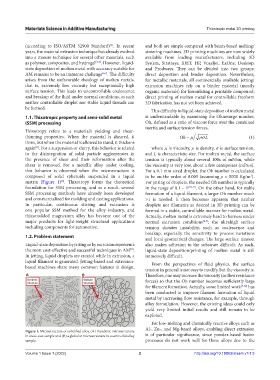
            again . For a suspension or slurry, this behavior is related   where µ is viscosity, ρ is density, σ is surface tension,
                [8]
            to  the  disintegration  of  solid  particle  agglomerates  in   and L is characteristic size. For molten metal, the surface
            the presence of shear and their reformation after the   tension is typically about several 100s of mN/m, while
            shear is removed. For a metallic alloy under cooling,   the viscosity is very low, about a few centipoises (mPa⋅s).
            this behavior is observed when the microstructure is   For a 0.1 mm sized droplet, the Oh number is calculated
            composed of solid spheroids suspended in a liquid   to be on the order of 0.005 (assuming ρ ≈ 5000 Kg/m ).
                                                                                                            3
            matrix (Figure  1) . Thixotropy forms the theoretical   For jetting of droplets, the needed Oh number is typically
                           [8]
            foundation for SSM processing, and as a result, several   in the range of 0.1 – 1 [10,11] . On the other hand, for stable
            SSM  processing  methods  have  already  been developed   formation of a liquid filament, a larger Oh number much
            and commercialized for molding and casting applications.   >1  is  needed. It then becomes apparent  that  neither
            In particular, continuous stirring and extrusion is   droplets nor filaments as desired in 3D printing can be
            one  popular  SSM  method  for  the  alloy  industry,  and   formed in a stable, controllable manner for molten metal.
            thixomolded magnesium alloy has become one of the   Actually, molten metal is extremely hard to harness under
            major products for light-weight structural applications   normal extrusion conditions [6,7] ; the ultrahigh surface
            including components for automotive.               tension dictates instability, such as coalescence and
                                                               breakup, especially the sensitivity to process variations
            1.2. Problem statement                             and local geometrical changes. The large surface tension
            Liquid-state deposition by jetting or by extrusion represents   also makes adhesion to the substrate difficult. As such,
            the most cost-effective and successful techniques in AM .   liquid-state deposition/printing of molten metal is still
                                                        [9]
            In jetting, liquid droplets are created while in extrusion, a   immensely difficult.
            liquid filament is generated. Jetting-based and extrusion-  From the perspectives of fluid physics, the surface
            based machines share many common features in design,
                                                               tension in general is not easy to modify, but the viscosity is.
            A                       B                          Therefore, one may increase the viscosity (or flow resistance
                                                               forces) so that the Oh number becomes sufficiently large
                                                               for filament formation. Actually, some limited work [7,12]  has
                                                               been conducted to improve filament formation of liquid
                                                               metal by increasing flow resistance, for example, through
                                                               alloy formulation. However, the existing ideas could only
                                                               yield very limited initial results and still remain to be
                                                               explored.
                                                                 For low-melting and chemically reactive alloys such as
                                                               Al-, Zn-, and Mg-based alloys, enabling direct extrusion
            Figure 1. Microstructure of solidified alloy. (A) Dendritic microstructure
            in an as-cast sample and (B) a globular microstructure in a semisolid alloy   is of particular significance, since powder-based fusion
            sample.                                            processes do not work well for these alloys due to the

            Volume 1 Issue 1 (2022)                         2                       http://doi.org/10.18063/msam.v1i1.5

