


Page 63 - MSAM-1-1
P. 63
Materials Science in Additive Manufacturing                                  Thixotropic metal 3D printing


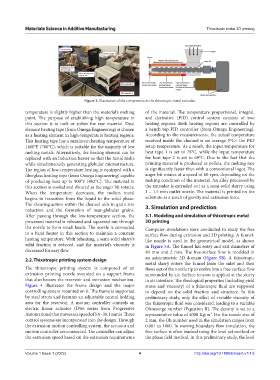
                                     Figure 3. Illustration of the components in the thixotropic metal extruder.

            temperature is slightly higher than the material’s melting   of the material. The temperature proportional, integral,
            point. The purpose of establishing high temperature in   and derivative (PID) control system consists of two
            this section is to melt or soften the raw material. Dual   heating regions. Both heating regions are controlled by
            element heating tape (from Omega Engineering) is chosen   a bench top PID controller (from Omega Engineering).
            as a heating element in high-temperature heating regions.   According to the measurements, the actual temperature
            This heating tape has a maximum heating temperature of   received inside the channel is on average 5°C< the PID
            1400°F (760°C), which is suitable for the majority of low   setup temperature. As a result, the input temperature for
            melting metals. Alternatively, the heating element can be   heat  tape 1  is  set  to  78°C,  while  the  input  temperature
            replaced with an induction heater so that the metal melts   for heat tape 2 is set to 69°C. Due to the fact that the
            while simultaneously generating globular microstructure.   printing material is produced as pellets, the melting rate
            The region of low-temperature heating is equipped with a   is significantly faster than with a conventional ingot. The
            fiberglass heating rope (from Omega Engineering) capable   auger bit rotates at a speed of 60 rpm, depending on the
            of producing heat up to 900°F (482°C). The material in   melting condition of the material. An alloy processed by
            this section is cooled and sheared as the auger bit rotates.   the extruder is extruded out as a semi-solid slurry using
            When the temperature decreases, the molten metal   1 – 1.5 mm outlet nozzle. The material is printed on the
            begins to transition from the liquid to the solid phase.   substrate as a result of gravity and extrusion force.
            The shearing action within the channel aids in grain size
            reduction and the formation of near-globular grains.   3. Simulation and prediction
            After  passing through the  low-temperature section,  the   3.1. Modeling and simulation of thixotropic metal
            processed material is reheated and squeezed out through   3D printing
            the nozzle to form small beads. The nozzle is connected   Computer simulations were conducted to study the free
            to a band heater in this section to maintain a constant   surface flow during extrusion and 3D printing. A funnel-
            heating temperature. With reheating, a semi-solid slurry’s   like nozzle is used in the geometrical model, as shown
            solid  fraction is  reduced, and  the material’s  viscosity  is   in Figure 5A. The funnel has entry and exit diameters of
            decreased for easy flow.                           40  mm and 2  mm. The free-surface flow is modeled in
            2.2. Thixotropic printing system design            an axisymmetric 2D domain (Figure  5B). A  thixotropic
                                                               metal  slurry enters the funnel from the  inlet and then
            The  thixotropic  printing  system  is  composed  of  an   flows out of the nozzle tip to evolve into a free-surface flow
            extrusion printing nozzle mounted on a support frame   surrounded by air. Surface tension is applied at the slurry
            that also houses the reservoir and extrusion mechanism.   to air interface. The rheological properties (including yield
            Figure  4 illustrates the frame design and the major   stress and viscosity) of a thixotropic fluid are supposed
            controlling system mounted on it. The frame is supported   to depend on the solid fraction and structure. In this
            by steel struts and features an adjustable central holding   preliminary study, only the effect of variable viscosity of
            area for the reservoir. A  motion controller controls an   the thixotropic fluid was considered, leading to a variable
            electric linear actuator (IP66 series from Progressive   Ohnesorge number (Equation II). The density is set to a
            Automations) that moves at a speed of 3.8–38.1 mm/s. Three   representative value of 4000 Kg/m . For the nozzle size of
                                                                                          3
            control systems are incorporated into the design. Through   2 mm, the Oh number used in the simulation ranges from
            the extrusion motion controlling system, the actuator and   0.001 to 1000. In moving boundary flow simulation, the
            motion controller are connected. The controller can adjust   free surface is often tracked using the level set method or
            the extrusion speed based on the extrusion requirements   the phase field method. In this preliminary study, the level


            Volume 1 Issue 1 (2022)                         4                       http://doi.org/10.18063/msam.v1i1.5

