


Page 68 - MSAM-1-1
P. 68
Materials Science in Additive Manufacturing                                  Thixotropic metal 3D printing


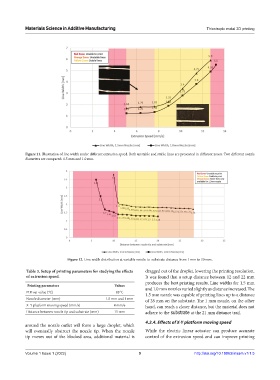
            Figure 11. Illustration of line width under different extrusion speed. Both unstable and stable lines are presented in different zones. Two different nozzle
            diameters are compared: 1.5 mm and 1.0 mm.


                              Figure 12. Line width distribution at variable nozzle-to-substrate distance from 1 mm to 30 mm.

            Table 3. Setup of printing parameters for studying the effects   dragged out of the droplet, lowering the printing resolution.
            of extrusion speed.                                It was found that a setup distance between 12 and 22 mm
                                                               produces the best printing results. Line widths for 1.5 mm
             Printing parameters                  Values       and 1.0 mm nozzles varied slightly as distance increased. The
            PID set value (°C)                    83°C         1.5 mm nozzle was capable of printing lines up to a distance
            Nozzle diameter (mm)              1.5 mm and 1 mm
                                                               of 28 mm on the substrate. The 1 mm nozzle, on the other
            X-Y platform moving speed (mm/s)     4 mm/s        hand, can reach a closer distance, but the material does not
            Distance between nozzle tip and substrate (mm)  15 mm  adhere to the substrate at the 21 mm distance trail.

                                                               4.2.4. Effects of X-Y platform moving speed
            around the nozzle outlet will form a large droplet, which
            will eventually obstruct the nozzle tip. When the nozzle   While the electric linear actuator can produce accurate
            tip moves out of the blocked area, additional material is   control of the extrusion speed and can improve printing


            Volume 1 Issue 1 (2022)                         9                       http://doi.org/10.18063/msam.v1i1.5

