


Page 69 - MSAM-1-1
P. 69
Materials Science in Additive Manufacturing                                  Thixotropic metal 3D printing


            resolution, the actuator’s maximum and minimum
            movement capabilities limit printing effects. When the
            extrusion speed is set within a specified range, another
            significant parameter that can be adjusted is the X-Y
            platform movement speed. Two motorized linear actuators
            provide X- and Y-axis movement for the printing system.
            The moving stage’s parameters can be configured through
            CNC control software. Acceleration along both axes was
            the first parameter considered in this study. Based on
            the motor movement profile, the CNC control software
            selected an acceleration value of approximately 50 mm/s .
                                                         2
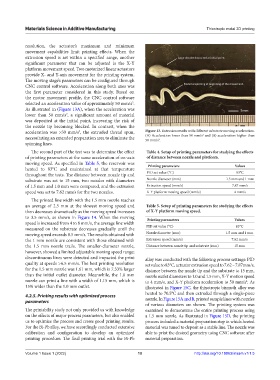
            As illustrated in (Figure 13A), when the acceleration was
                             2
            lower than 50  mm/s , a significant amount of material
            was deposited at the initial point, increasing the risk of
            the nozzle tip becoming blocked. In contrast, when the
            acceleration was >50  mm/s , the extruded thread spun,   Figure 13. Extrusion results with different substrate moving acceleration.
                                   2
                                                                                       2
            necessitating an extended preparation area to eliminate the   (A) Acceleration lower than 50 mm/s  and (B) acceleration higher than
                                                               50 mm/s .
                                                                    2
            spinning lines.
              The second part of the test was to determine the effect   Table 4. Setup of printing parameters for studying the effects
            of printing parameters at the same acceleration of on-axis   of distance between nozzle and platform.
            moving speed. As specified in Table 5, the reservoir was   Printing parameters           Values
            heated to 83°C and maintained at that temperature
            throughout the tests. The distance between nozzle tip and   PID set value (°C)            83°C
            substrate was set to 15 mm, two nozzles with diameters   Nozzle diameter (mm)        1.5 mm and 1 mm
            of 1.5 mm and 1.0 mm were compared, and the extrusion   Extrusion speed (mm/s)          7.87 mm/s
            speed was set to 7.62 mm/s for the two nozzles.    X-Y platform moving speed (mm/s)      4 mm/s
              The printed line width with the 1.5 mm nozzle reaches
            an average of 2.5  mm at the slowest moving speed and   Table 5. Setup of printing parameters for studying the effects
            then decreases dramatically as the moving speed increases   of X-Y platform moving speed.
            to  3.5  mm/s,  as  shown  in  Figure  14.  When  the  moving   Printing parameters      Values
            speed is increased from 4 to 8 mm/s, the average line width
            measured on the substrate decreases gradually until the   PID set value (°C)             83°C
            moving speed exceeds 8.5 mm/s. The results obtained with   Nozzle diameter (mm)      1.5 mm and 1 mm
            the 1 mm nozzle are consistent with those obtained with   Extrusion speed (mm/s)        7.62 mm/s
            the 1.5  mm nozzle trails. The smaller-diameter nozzle,   Distance between nozzle tip and substrate (mm)   15 mm
            however, showed a limited adjustable moving speed range;
            discontinuous lines were detected and impacted the print   alloy was conducted with the following process settings: PID
            quality at speeds >6.5 mm/s. The best printing resolution   set value to 83°C, actuator extrusion speed to 7.62 – 7.87mm/s,
            for the 1.5 mm nozzle was 1.61 mm, which is 7.33% larger   distance between the nozzle tip and the substrate to 15 mm,
            than the initial outlet diameter. Meanwhile, the 1.0 mm   nozzle outlet diameters to 1.0 and 1.5 mm, X-Y motion speed
            nozzle can print a line with a width of 1.15 mm, which is   to 4 mm/s, and X-Y platform acceleration to 50 mm/s . As
                                                                                                          2
            15% wider than the 1.0 mm outlet.                  illustrated in Figure 15C, the thixotropic bismuth alloy was
            4.2.5. Printing results with optimized process     heated to 70.5°C and then extruded through a single-piece
            parameters                                         nozzle. In Figure 15A and B, printed sample lines with nozzles
                                                               of various diameters are shown. The printing system was
            The printability study not only provided us with knowledge   examined to demonstrate the entire printing process using
            on the effects of major process parameters, but also enabled   a 1.5 mm nozzle. As illustrated in Figure 15D, the printing
            us to optimize the process and create good printing results.   process included a material preparation step in which heated
            For the Bi-Pb alloy, we have accordingly conducted extensive   material was tuned to deposit as a stable line. The nozzle was
            calibration and configuration to develop an optimized   able to print the desired geometry using CNC software after
            printing procedure. The final printing trial with the Bi-Pb   material preparation.


            Volume 1 Issue 1 (2022)                         10                      http://doi.org/10.18063/msam.v1i1.5

