


Page 64 - MSAM-1-1
P. 64
Materials Science in Additive Manufacturing Thixotropic metal 3D printing
Figure 4. Plunger extrusion-based printing system design.
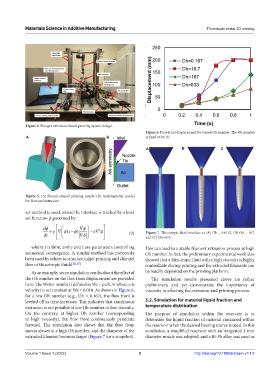
Figure 6. Flow front displacement for varied Oh number. The We number
A B is fixed at 0.018.
A B C
Figure 5. (A) Funnel-shaped printing nozzle. (B) Axisymmetric model
for flow and extrusion.
set method is used, where the interface is tracked by a level
set function ϕ governed by
dφ + γ ∇ φ − )φ ∇φ (1 − ε∇ 2 φ
dt ∇φ (2) Figure 7. Thixotropic fluid interface at (A) Oh = 0.0167, (B) Oh = 167,
and (C) Oh=833.
where t is time, and γ and ε are parameters controlling This can lead to a stable filament extrusion process at high
numerical convergence. A similar method has previously Oh number. In fact, the preliminary experimental work also
been used by others to simulate inkjet printing and channel showed that a thixotropic fluid with a high viscosity is highly
flow of thixotropic fluids [16,17] . controllable during printing and the extruded filaments can
As an example, some simulation results about the effect of be readily deposited on the printing platform.
the Oh number on the flow front displacement are provided The simulation results presented above are rather
here. The Weber number (defined as We = ρu L /σ where u is preliminary, and yet demonstrate the importance of
2
velocity) is set constant at We = 0.018. As shown in Figure 6, viscosity in affecting the extrusion and printing process.
for a low Oh number (e.g., Oh = 0.167), the flow front is
leveled off as time increases. This indicates that continuous 3.2. Simulation for material liquid fraction and
extrusion is not possible at low Oh number or low viscosity. temperature distribution
On the contrary, at higher Oh number (corresponding The purpose of simulation within the reservoir is to
to high viscosity), the flow front continuously penetrate determine the liquid fraction of material contained within
forward. The simulation also shows that the flow front the reservoir when the desired heating source is used. In this
moves slower at a high Oh number, and the diameter of the simulation, a simplified reservoir with an integrated 1 mm
extruded filament becomes larger (Figure 7 for a snapshot). diameter nozzle was adopted, and a Bi-Pb alloy was used as
Volume 1 Issue 1 (2022) 5 http://doi.org/10.18063/msam.v1i1.5

