


Page 62 - MSAM-1-1
P. 62
Materials Science in Additive Manufacturing                                  Thixotropic metal 3D printing


            passivation layer . Cost-effective printing of these alloys   whole process can be contained within one machine so
                         [1]
            would  lead  to  a  revolutionary  improvement  on  the   that the need for melting and holding furnaces as well as
            products of medical devices, engineering and industrial   melt treatment are all avoided. Foundry cleanliness is easy
            product and beyond. Therefore, a new technical approach   to maintain, and energy requirements are less because
            for breaking the physical limit set by an extremely low   complete melting is not required, cycle times are reduced,
            Ohnesorge number of molten alloy and enabling direct   and  scrap  is  minimized.  (2)  Shrinkage  and  cracking
            printing is highly desired.                        within the mold are reduced because the alloy is already
                                                               partly solidified in cast. (3) Lower operating and pouring
            1.3. Manufacturing process and system              temperatures lead to an increase in the life of metal dies.
            development                                        (4) Composite materials can be readily produced by
            The main objective of this research is to explore a novel   adding microspheres, fibers, or other solid particulates
            manufacturing system that is capable of thixotropic   into the feedstock (often referred to as compo casting).
            processing and 3D printing of low-melting-point alloys such   Despite  these  advantages,  all  existing  processes  need  a
            as Al, Mg, and Zn alloys into various devices and products.   mold for shaping. The thixotropy generated in existing
            To enable direct extrusion of molten metal, one has to find   processes is considered not adequate and suitable for 3D
            a practically viable approach for substantially increasing   printing. The solid inclusions in these processes are large in
            the Ohnesorge number. From Equation (I), this requires   size and irregular in shape, often containing large dendritic
            increasing of viscosity or decreasing of surface tension.   structures. In this research, a mixer was designed for
            Therefore, one has to modify the material properties of the   producing a printable micro-slurry from metallic alloys.
            liquid metal by increasing the flow stress and decreasing the   The desired micro-slurry should be a two-phase structure,
            negative effects from the high surface tension. In this study,   containing a fine β-phase grains (of a high melting point)
            some low melting point alloys were made into a thixotropic   uniformly dispersed in a molten  α-phase. This micro-
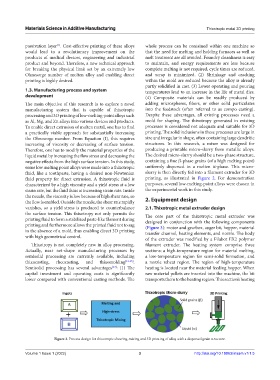
            fluid,  like  a  toothpaste,  having  a  desired  non-Newtonian   slurry is then directly fed into a filament extruder for 3D
            fluid property for direct extrusion. A  thixotropic fluid is   printing,  as  illustrated  in  Figure  2.  For  demonstration
            characterized by a high viscosity and a yield stress at a low   purposes, several low-melting-point alloys were chosen in
            strain rate, but the fluid thins at increasing strain rate. Inside   the experimental work in this study.
            the nozzle, the viscosity is low because of high shear rate, so
            the flow is enabled. Outside the nozzle, the shear rate rapidly   2. Equipment design
            vanishes, so a yield stress is produced to counterbalance   2.1. Thixotropic metal extruder design
            the surface tension. This thixotropy not only permits the   The core part of the thixotropic metal extruder was
            printing fluid to form a stabilized paste-like filament during   designed in conjunction with the following components
            printing and furthermore allows the printed fluid not to sag   (Figure 3): motor and gearbox, auger bit, hopper, material
            in the absence of a mold, thus enabling direct 3D printing   transfer channel, heating elements, and nozzle. The body
            with high geometrical control.
                                                               of the extruder was modified by a Filabot EX2 polymer
              Thixotropy is not completely new in alloy processing.   filament extruder. The heating system comprise three
            Actually, near net-shape manufacturing processes by   sections: a high-temperature region for material melting,
            semisolid  processing  are  currently  available,  including   a low-temperature region for semi-solid formation, and
            thixocasting,  rheocasting,  and  thixomolding [13-15] .   a nozzle reheat region. The region of high-temperature
            Semisolid  processing has  several  advantages : (1)  The   heating is located near the material feeding hopper. When
                                                 [13]
            capital investment and operating costs is significantly   raw material pellets are inserted into the machine, the bit
            lower compared with conventional casting methods. The   transports them to the heating region. This section’s heating


                        Figure 2. Process design for thixotropic shearing-mixing and 3D printing of alloy with a dispersed grain structure.


            Volume 1 Issue 1 (2022)                         3                       http://doi.org/10.18063/msam.v1i1.5

