


Page 67 - MSAM-1-1
P. 67
Materials Science in Additive Manufacturing                                  Thixotropic metal 3D printing


            Table 1. Setup of printing parameters for the test to study the   using nozzles with outlet diameters of 1 mm and 1.5 mm.
            effects of nozzle size.                            The width of each printed line was measured, and the
                                                               results are plotted and compared, as shown in Figure 11.
             Printing parameters                    Values
            PID set value (°C)                       83°C        As illustrated in Figure 11, both the 1.5 mm and 1.0 mm
            Extrusion speed (mm/s)                 7.87 mm/s   nozzles were started at a 3.81 mm/s minimum extrusion
                                                               speed. None of these nozzles, however, can print continuous
            X-Y platform moving speed (mm/s)        4 mm/s     straight lines at low speeds. Both nozzles can extrude
            Distance between nozzle tip and substrate (mm)  15 mm  thixotropic alloy on a substrate with a specified length at a
                                                               rate of 5.08 mm/s, but the printing process was not stable.
            Table 2. Comparison of average (5 times) line width with   When the extrusion speed was  increased to  6.35  mm/s,
            different nozzle diameter.                         the instability issue still remained, and the 1 mm nozzle
                                                               had a higher chance of producing discontinuous lines.
             Nozzle diameter (mm)  Average line width (mm)  % Difference  Stable measurements were taken at an extrusion speed
            1.5                      1.85          23.45%      of approximately 7.62 mm/s. A nozzle with a diameter of
            1.0                      1.32          32.05%      1.5 mm can print a continuous line with an average width
            0.8                      1.01          31.21%      of 1.83 mm at this extrusion speed. A 1.0 mm nozzle can
                                                               produce lines with a width of 1.34 mm at the same speed.
                                                               Increased extrusion speed resulted in more material
                                                               being squeezed out of the nozzle tip, which increased the
                                                               measured line width as well. The final speed recorded in
                                                               this test was 13.21 mm/s, and both nozzles produced lines
                                                               with a width of more than 5.5 mm. In particular, with the
                                                               1.5 mm diameter nozzle trial, the material flooded out of the
                                                               outlet at an alarming rate, making it impossible to continue
                                                               printing lines. Under the same printing conditions, both
                                                               1 mm and 1.5 mm nozzles require enough backpressure
                                                               and shear rate inside the reservoir to change the thixotropic
                                                               properties. Therefore, increasing the extrusion speed
                                                               can instantly raise the shear rate, decreasing the material
                                                               viscosity. However, when extrusion speed exceeds the stable
                                                               printing zone, the thixotropic proprieties are no longer the
                                                               primary factor to control the material flow rate.

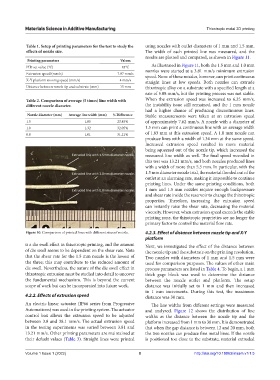
            Figure 10. Comparison of printed lines with different sizes of nozzle.  4.2.3. Effect of distance between nozzle tip and X-Y
                                                               platform
            is a die swell effect in thixotropic printing, and the amount   Next, we investigated the effect of the distance between
            of die swell seems to be dependent on the shear rate. Note   the nozzle tip and the substrate on the printing resolution.
            that the shear rate for the 1.5 mm nozzle is the lowest of   Two nozzles with diameters of 1 mm and 1.5 mm were
            the three; this may contribute to the reduced amount of   used for comparison purposes. The values of other main
            die swell. Nevertheless, the nature of the die swell effect in   process parameters are listed in Table 4. To begin, a 1 mm
            thixotropic extrusion must be studied into detail to uncover   thick gage block was used to determine the distance
            the fundamental mechanism. This is beyond the current   between the nozzle outlet and platform. The setup
            scope of work but can be incorporated into future work.  distance was initially set to 1  mm and then increased
                                                               in  1  mm  increments. During this  test, the  maximum
            4.2.2. Effects of extrusion speed                  distance was 30 mm.
            An electric linear actuator (IP66 series from Progressive   The line widths from different settings were measured
            Automations) was used in the printing system. The actuator   and analyzed.  Figure  12 shows the distribution of line
            control box allows the extrusion speed to be adjusted   widths as the distance between the nozzle tip and the
            between 3.8 and 38.1 mm/s. The actual extrusion speed   platform increased from 1 mm to 30 mm. It is demonstrated
            in the testing experiments was varied between 3.81 and   that when the gap distance is between 12 and 20 mm, both
            13.21 mm/s. Other printing parameters are maintained at   the two nozzles can produce fine metal lines. If the nozzle
            their default values (Table 3). Straight lines were printed   is positioned too close to the substrate, material extruded


            Volume 1 Issue 1 (2022)                         8                       http://doi.org/10.18063/msam.v1i1.5

