


Page 66 - MSAM-1-1
P. 66
Materials Science in Additive Manufacturing                                  Thixotropic metal 3D printing


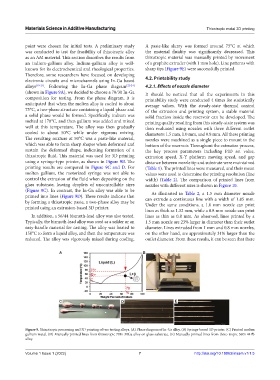
            point were chosen for initial tests. A  preliminary study   A  paste-like slurry was formed around 75°C at which
            was conducted to test the feasibility of thixotropic alloy   the material fluidity was significantly decreased. This
            as an AM material. This section describes the results from   thixotropic material was manually printed by movement
            an indium-gallium alloy. Indium-gallium alloy is well-  of a graphite extruder (with 1 mm hole). Line patterns with
            known for its electrochemical and rheological properties.   sharp tips (Figure 9E) were successfully printed.
            Therefore, some researchers have focused on developing
            electronic circuits and microchannels using In-Ga based   4.2. Printability study
            alloys [19-21] . Following the In-Ga phase  diagram [22-24]    4.2.1. Effects of nozzle diameter
            (shown in Figure 9A), we decided to choose a 70/30 In-Ga   It should be noticed that all the experiments in this
            composition for testing. From the phase  diagram, it is   printability study were conducted 4 times for statistically
            anticipated that when the molten alloy is cooled to about   average values. With the steady-state thermal control
            75°C, a two-phase structure containing a liquid phase and   of the extrusion and printing system, a stable material
            a solid phase would be formed. Specifically, indium was   solid fraction inside the reservoir can be developed. The
            melted at 170°C, and then gallium was added and mixed   printing quality resulting from this steady-state system was
            well at this temperature. The alloy was then gradually   then evaluated using nozzles with three different outlet
            cooled to about 50°C while under vigorous mixing.   diameters: 1.5 mm, 1.0 mm, and 0.8 mm. All these printing
            The resulting mixture at 50°C was a paste-like material,   nozzles were machined as a single piece to mount to the
            which was able to form sharp shapes when deformed and   bottom of the reservoir. Throughout the extrusion process,
            sustain the deformed shape, indicating formation of a   the key process parameters including PID set value,
            thixotropic fluid. This material was used for 3D printing   extrusion speed, X-Y platform moving speed, and gap
            using a syringe-type printer, as shown in Figure 9B. The   distance between nozzle tip and substrate were maintained
            printing results are compared in  Figure  9C  and D. For   (Table 1). The printed lines were measured, and their mean
            molten gallium, the motorized syringe was not able to   values were used to determine the printing resolution (line
            control the extrusion of the fluid when depositing on the   width) (Table 2). The comparison of printed lines from
            glass  substrate,  leaving  droplets  of uncontrollable sizes   nozzles with different sizes is shown in Figure 10.
            (Figure  9C). In contrast, the In-Ga alloy was able to be   As illustrated in  Table 2, a 1.5  mm diameter nozzle
            printed into lines (Figure 9D). These results indicate that   can extrude a continuous line with a width of 1.85 mm.
            by forming a thixotropic paste, a two-phase alloy may be
            printed using an extrusion-based 3D printer.       Under the same conditions, a 1.0  mm nozzle can print
                                                               lines as thick as 1.32 mm, while a 0.8 mm nozzle can print
              In addition, a 56/44 bismuth-lead alloy was also tested.   lines as thin as 0.8  mm.  As  observed, lines  printed by a
            Typically, the bismuth-lead alloy was used as a solder or an   1.5 mm nozzle are 23% larger in diameter than their outlet
            easy-handle material for casting. The alloy was heated to   diameter. Lines extruded from 1 mm and 0.8 mm nozzles,
            150°C to form a liquid alloy, and then the temperature was   on the other hand, are approximately 31% larger than the
            reduced. The alloy was vigorously mixed during cooling.   outlet diameter. From these results, it can be seen that there

                          A                                   B


                          C                          D                     E


            Figure 9. Thixotropic processing and 3D printing of two testing alloys. (A) Phase diagram of In-Ga alloy. (B) Syringe-based 3D printer. (C) Printed molten
            gallium metal. (D) Manually printed lines from thixotropic 70In-30Ga alloy on glass substrate. (E) Manually printed lines from thixo-tropic 56Bi-44Pb
            alloy.


            Volume 1 Issue 1 (2022)                         7                       http://doi.org/10.18063/msam.v1i1.5

