


Page 54 - MSAM-1-1
P. 54
Materials Science in Additive Manufacturing                      From 3D printed molds to bioprinted scaffolds


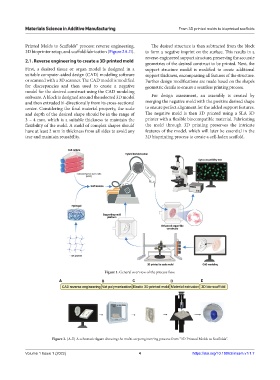
            Printed Molds to Scaffolds” process: reverse engineering,   The desired structure is then subtracted from the block
            3D bioprinter setup, and scaffold fabrication (Figure 2A-E).  to form a negative imprint on the surface. This results in a
                                                               reverse-engineered support structure, preserving the accurate
            2.1. Reverse engineering to create a 3D printed mold
                                                               geometries of the desired construct to be printed. Next, the
            First, a desired tissue or organ model is designed in  a   support structure model is modified to create additional
            suitable computer-aided design (CAD) modeling software   support thickness, encompassing all features of the structure.
            or scanned with a 3D scanner. The CAD model is modified   Further design modifications are made based on the shape’s
            for discrepancies and then used to create a negative   geometric details to ensure a seamless printing process.
            model for the desired construct using the CAD modeling
            software. A block is designed around the selected 3D model   For design assessment, an assembly is created by
            and then extruded bi-directionally from its cross-sectional   merging the negative mold with the positive desired shape
            center. Considering the final material property, the scale   to ensure perfect alignment for the added support features.
            and depth of the desired shape should be in the range of   The negative mold is then 3D printed using a SLA 3D
            3 – 4 mm, which is a suitable thickness to maintain the   printer with a flexible biocompatible material. Fabricating
            flexibility of the mold. A mold of complex shapes should   the mold through 3D printing preserves the intricate
            have at least 2 mm in thickness from all sides to avoid any   features of the model, which will later be essential in the
            tear and maintain reusability.                     3D bioprinting process to create a cell-laden scaffold.


                                              Figure 1. General overview of the process flow.
                          A                 B            C                D           E


                       Figure 2. (A-E) A schematic figure showing the multi-step engineering process from “3D Printed Molds to Scaffolds”.


            Volume 1 Issue 1 (2022)                         4                      https://doi.org/10.18063/msam.v1i1.7

