


Page 8 - MSAM-2-2
P. 8
Materials Science in Additive Manufacturing                        Union of 2D nanomaterials and 3D printing


            injuries, such as fractures, car accidents, and foreign body
            invasion, or non-traumatic injuries, such as tumors and
            neurodegenerative diseases [2,3] . Such injuries are typically
            accompanied by axonal and myelin damage, neuronal
            cell death or necrosis, astrocyte and microglial activation,
            immune cell infiltration, and inflammation [4-6] . The PNS is
            more susceptible to internal or external injuries than the
            CNS due to the absence of a rigid bony layer and protection
            from the blood-brain barrier . Conventional treatments
                                    [7]
            encounter significant obstacles when it comes to promoting
            neurogenesis and facilitating neuronal functional recovery.
            Typically, autografts or allografts are introduced to repair
            nerve damage; yet, this approach presents various limitations,
            including the limited capability of adsorbing multiple drug
            molecules and lack of precise control over release kinetics .
                                                        [8]
              Recently, two-dimensional (2D) nanomaterials have been
            discovered to possess exceptional electrical conductivity,
            which is beneficial for growing specific cells such as muscle
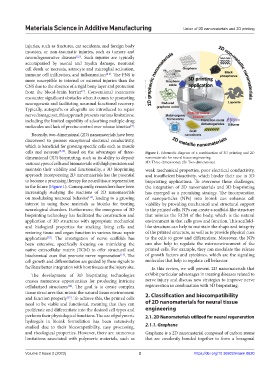
            cells and neurons [9,10] . Based on the advantages of three-  Figure 1. Schematic diagram of a combination of 3D printing and 2D
            dimensional (3D) bioprinting, such as its ability to deposit   nanomaterials for neural tissue engineering.
            various types of cells and biomaterials with high precision and   3D: Three-dimensional; 2D: Two-dimensional.
            maintain their viability and functionality, a 3D bioprinting   weak mechanical properties, poor electrical conductivity,
            approach incorporating 2D nanomaterials has the potential   and insufficient bioactivity, which hinder their use in 3D
            to become a promising therapy for neural tissue regeneration   bioprinting applications. To overcome these challenges,
            in the future (Figure 1). Consequently, researchers have been   the integration of 2D nanomaterials and 3D bioprinting
            increasingly studying the reactions of 2D nanomaterials   has  emerged  as  a  promising  strategy.  The  incorporation
            on modulating neuronal behavior , leading to a growing   of nanoparticles (NPs) into bioink can enhance cell
                                       [11]
            interest in using these materials as bioinks for treating   viability by providing mechanical and structural support
            neurological disorders. Furthermore, the emergence of 3D   to the printed cells. NPs can create a scaffold-like structure
            bioprinting technology has facilitated the construction and   that mimics the ECM of the body, which is the natural
            application of 3D structures with appropriate mechanical   environment in that cells grow and function. This scaffold-
            and biological properties for stacking living cells and   like structure can help to maintain the shape and integrity
            restoring tissue and organ function in various tissue repair   of the printed structure, as well as to provide physical cues
            applications .  The investigation of nerve scaffolds  has   to the cells to grow and differentiate. Moreover, the NPs
                     [12]
            been extensive, specifically focusing on mimicking the   can also help to regulate the microenvironment of the
            native extracellular matrix (ECM) to offer structural and   printed cells. For example, they can modulate the release
                                                    [13]
            biochemical cues that promote nerve regeneration . The   of growth factors and cytokines, which are the signaling
            cell growth and differentiation are guided by these signals to   molecules that help to regulate cell behavior.
            facilitate better integration with host tissues at the injury site.  In this review, we will present 2D nanomaterials that
              The development of 3D bioprinting technologies   exhibit particular advantages in treating diseases related to
            creates numerous opportunities for producing intricate   nerve injury and discuss new strategies to improve nerve
            cellularized structures . The goal is to create complex   regeneration in combination with 3D bioprinting.
                              [14]
            tissue structures that mimic the natural tissue environment   2. Classification and biocompatibility
            and function properly . To achieve this, the printed cells
                             [15]
            need to be viable and functional, meaning that they can   of 2D nanomaterials for neural tissue
            proliferate and differentiate into the desired cell types and   engineering
            perform their physiological functions. The use of polymeric   2.1. 2D Nanomaterials utilized for neural regeneration
            hydrogels in bioink formulation has been extensively
            studied due to their biocompatibility, easy processing,   2.1.1. Graphene
            and rheological properties. However, there are numerous   Graphene is a 2D nanomaterial composed of carbon atoms
            limitations associated  with polymeric materials,  such as   that  are  covalently  bonded  together to form a  hexagonal


            Volume 2 Issue 2 (2023)                         2                       https://doi.org/10.36922/msam.0620

