


Page 46 - MSAM-3-3
P. 46
Materials Science in Additive Manufacturing                   MEX optimization printing of rHPDE from milk jugs


            molten material was extruded through the die at 190°C.   nozzle. To optimize the printing of rHDPE filaments,
            The opening size  of the  hopper was  30 ×  20  mm.  The   we investigated several parameters, including print
            extrudate was cooled along a Filabot Airpath (Filabot,   bed material, print speed (PS), surface roughness (Ra),
            Vermont USA) (Figure  2) at an ambient temperature   as well as the print bed temperature (PBT) and print
            of 21.8°C before spooling. The Mitutoyo Filameasure   temperature (PT).
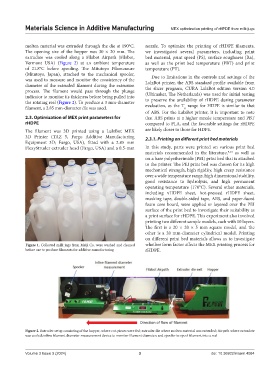
            (Mitutoyo, Japan), attached to the mechanical spooler,   Due to limitations in the controls and settings of the
            was used to measure and monitor the consistency of the   LulzBot printer, the ABS standard profile available from
            diameter of the extruded filament during the extrusion   the slicer program, CURA LulzBot edition version  4.0
            process. The filament would pass through the plunge   (Ultimaker, The Netherlands) was used for initial testing
            indicator to monitor its thickness before being pulled into   to preserve the availability of rHDPE during parameter
            the rotating reel (Figure 2). To produce a 3 mm-diameter
            filament, a 2.85 mm-diameter die was used.         evaluation,  as  the  T   range  for  HDPE  is  similar  to  that
                                                                               g
                                                               of  ABS.  For the LulzBot printer,  it is  important  to note
            2.3. Optimization of MEX print parameters for      that ABS prints at a higher nozzle temperature and PBT
            rHDPE                                              compared to PLA, and the favorable settings for rHDPE
            The filament was 3D printed using a LulzBot MEX    are likely closer to those for HDPE.
            3D Printer (TAZ 5, Fargo Additive Manufacturing    2.3.1. Printing on different print bed materials
            Equipment 3D; Fargo, USA), fitted with a 2.85  mm
            FlexyStruder extruder head (Fargo, USA) and a 0.5-mm   In this study, parts were printed on various print bed
                                                               materials recommended in the literature, 9-15  as well as
                                                               on a bare polyetherimide (PEI) print bed that is attached
                                                               to the printer. The PEI print bed was chosen for its high
                                                               mechanical strength, high rigidity, high creep resistance
                                                               over a wide temperature range, high dimensional stability,
                                                               good resistance to hydrolysis, and high permanent
                                                               operating temperature (170°C). Several other materials,
                                                               including vHDPE sheet, hot-pressed rHDPE sheet,
                                                               masking tape, double-sided tape, ABS, and paper-faced
                                                               foam core board, were applied or layered over the PEI
                                                               surface of the print bed to investigate their suitability as
                                                               a print surface for rHDPE. This experiment also involved
                                                               printing two different sample models, each with 10 layers.
                                                               The first is a 20 × 20 × 5  mm square model, and the
                                                               other is a 20 mm-diameter cylindrical model. Printing
                                                               on different print bed materials allows us to investigate
            Figure 1. Collected milk jugs from Meiji Co. were washed and cleaned   whether form factor affects the MEX printing process for
            before use to produce filaments for additive manufacturing  rHDPE.


            Figure 2. Extruder setup consisting of the hopper, where cut-pieces were fed; extruder die where molten material was extruded; Airpath where extrudate
            was cooled; inline filament diameter measurement device to monitor filament diameter; and spooler to spool filament into a reel


            Volume 3 Issue 3 (2024)                         3                              doi: 10.36922/msam.4084

