


Page 47 - MSAM-3-3
P. 47
Materials Science in Additive Manufacturing                   MEX optimization printing of rHPDE from milk jugs


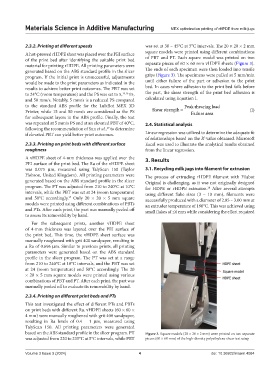
            2.3.2. Printing at different speeds                was set at 30 – 45°C at 5°C intervals. The 20 × 20 × 2 mm

            A hot-pressed rHDPE sheet was placed over the PEI surface   square models were printed using different combinations
            of the print bed after identifying the suitable print bed   of PBT and PT. Each square model was printed on two
            material for printing rHDPE. All printing parameters were   separate pieces of 60 × 60 mm vHDPE sheets (Figure 3).
            generated based on the ABS standard profile in the slicer   The ends of each specimen were then loaded into tensile
            program. If the initial print is unsuccessful, adjustments   grips (Figure 3). The specimens were pulled at 5 mm/min
            would be made to the print parameters as indicated in the   until either failure of the part or adhesion to the print
            results to achieve better print outcomes. The PBT was set   bed. In cases where adhesion to the print bed fails before
            to 24°C (room temperature) and the PS was set to 5, 14,16  15,   the part, the shear strength of the print bed adhesion is
            and 50 mm/s. Notably, 5 mm/s is a reduced PS compared   calculated using Equation I.
            to the standard ABS profile for the LulzBot MEX 3D                 Peak shearing load
            Printer, while 15 and 50 mm/s are considered as the PS   Shear strength =  Failure area        (I)
            for subsequent layers in the ABS profile. Finally, the test
            was repeated at 5 mm/s PS and at an elevated PBT of 40°C,   2.4. Statistical analysis
            following the recommendation of Sun et al.,  to determine
                                              17
            if elevated PBT can yield better print outcomes.   Linear regression was utilized to determine the adequate fit
                                                               of relationships based on the R value obtained. Microsoft
                                                                                        2
            2.3.3. Printing on print beds with different surface   Excel was used to illustrate the analytical results obtained
            roughness                                          from the linear regression.
            A vHDPE sheet of 4-mm thickness was applied over the   3. Results
            PEI surface of the print bed. The Ra of the vHDPE sheet
            was 0.075  μm, measured using  TalyScan 150  (Taylor   3.1. Recycling milk jugs into filament for extrusion
            Hobson, United Kingdom). All printing parameters were   The process of extruding rHDPE filament with Filabot
            generated based on the ABS standard profile in the slicer   Original is challenging, as it was not originally designed
            program. The PT was adjusted from 210 to 240°C at 10°C   for HDPE or rHDPE extrusion.  After several attempts
                                                                                         18
            intervals, while the PBT was set at 24 (room temperature)   using different flake sizes (3 – 10  mm), filaments were
            and 50°C accordingly.  Only 20  × 20  × 5  mm  square   successfully produced with a diameter of 2.85 – 3.00 mm at
                              17
            models were printed using different combinations of PBTs   an extruder temperature of 190°C. This was achieved using
            and PTs. After each print, the part was manually peeled off   small flakes of ≤6 mm while considering the effort required
            to assess its removability by hand.
              For the subsequent prints, another vHDPE sheet
            of 4-mm thickness was layered over the PEI surface of
            the print bed. This time, the vHDPE sheet surface was
            manually roughened with grit 400 sandpaper, resulting in
            a Ra of 0.696 μm. Similar to previous prints, all printing
            parameters  were  generated  based  on  the  ABS  standard
            profile in the slicer program. The PT was set at a range
            from 210 to 240°C at 10°C intervals, and the PBT was set
            at 24 (room temperature) and 50°C accordingly. The 20
            × 20 × 5 mm square models were printed using various
            combinations of PBT and PT. After each print, the part was
            manually peeled off to evaluate its removability by hand.

            2.3.4. Printing on different print beds and PTs
            This test investigated the effect of different PTs and PBTs
            on print beds with different Ra. vHDPE sheets (60 × 60 ×
            4 mm) were manually roughened with grit 400 sandpaper,
            resulting  in Ra  levels  of  0.4  –  1  μm,  measured using
            TalyScan 150. All printing parameters were generated
            based on the ABS standard profile in the slicer program. PT   Figure 3. Square models (20 × 20 × 2 mm) were printed on two separate
            was adjusted from 220 to 235°C at 5°C intervals, while PBT   pieces (60 × 60 mm) of the high-density polyethylene shear test setup


            Volume 3 Issue 3 (2024)                         4                              doi: 10.36922/msam.4084

