


Page 73 - MSAM-3-3
P. 73
Materials Science in Additive Manufacturing                          Gradient porous material design criteria


            1. Introduction                                    of understanding of how to achieve deformation-induced
                                                               densification through design, making it difficult to
            In previous research, porous structures play an important   predict their mechanical properties, including the energy
            role in the construction of lightweight parts and biomedical   absorption. 27
            implants. Metal foam is one of the conventional porous
            materials. However, porosity and pore size are hard to   In previous studies, various designs of gradient
            control during the process and thus the performance is   porosity materials have  been  investigated to  improve
            difficult to predict.  Therefore, porous structural materials   mechanical  properties.  Moreover,  deformation-induced
                           1,2
            using additive manufacturing technology have been   densification phenomena have been reported and are
            widely studied.  Regarding the additive manufacturing   thought to contribute to high energy absorption. However,
                        2-7
            process, three-dimensional materials are stacked layer by   systematic research is lacking to explore the design criteria
            layer according to the slicing data of the design model.    to achieve deformation-induced densification, and it
                                                         8,9
            Among these additive manufacturing technologies, two   would be beneficial for further applications if empirical
            types of methods are widely used to melt metal powder   rules for estimating energy absorption could be developed.
            together on the powder bed: selective laser melting and   Two types of porous structures/bionic structures, Schon-
            electron beam melting, which are also called laser powder   Gyroid and Schwarz-Diamond, were investigated in this
            bed fusion (LPBF) and electron beam powder bed fusion,   study to explore the design criteria for deformation-
            respectively.  By controlling microscale structural design,   induced densification of gradient porosity materials.
                     4,10
            porous structures with complex geometries can be easily   The porous structure materials were fabricated by LPBF
            formed, leading to an orderly porous structure without   using  Ti-6Al-4V  due  to  its  good  mechanical  properties
            redundant design.                                  and high specific strength.  Moreover, after exploring
                                                                                      28
              Many structures, such as orthogonal structures,   the relationship between the structure design and the
            rhombus structures, and helical structures, have been   deformation-induced densification phenomenon, the
            studied by other researchers. 11-17  In the present study,   relevant mechanical properties of the gradient porosity
            different porosity structures have been used in measuring   materials can therefore be predicted. As a result, the
            different kinds of mechanical properties. For example,   empirical rule for estimating the energy absorption of
            different unit cells are designed to improve the mechanical   gradient porosity materials can be developed.
            properties, 18-20  such as fatigue,  impact resistance,  and
                                     21
                                                     22
            energy absorption.  Furthermore, recently, triply periodic   2. Experimental procedures
                           23
            minimal surface (TPMS) has emerged as an ideal tool   In  this  study,  the  spherical  Ti-6Al-4V  alloy  powder
            to  generate  porous  structures.  Mathematical  functions   was  provided  by  Chung  Yo  Materials  Co., Ltd,  Taiwan.
            are used to construct the porous TPMS structure and   The powder size ranges mainly from 15 to 45  µm. All
            thus build the database of their physical and mechanical   the samples of Ti-6Al-4V alloy were printed using the
            properties. 9                                      SolidMEN AM 300 system with LPBF technology under
                                                                                       3
              Schon-Gyroid and Schwarz-Diamond models usually   an argon atmosphere of 1 × 10  mbar. The power, scanning
            exhibit good performance in terms of mechanical    speed, beam diameter, hatch distance, and layer thickness
            properties. 24,25  Recently, gradient porosity materials have   were 100 W, 1087.5 mm/s, 50 µm, 0.081 mm, and 30 µm,
            presented the application potential due to their excellent   respectively.
            energy absorption capacity. During the deformation,   All the compressive samples were designed as
            the struts first fracture in the region with the highest   rectangular columns with a width and length of 15 mm
            porosity, come into contact, get stuck with other struts,   and a height of 30  mm. The samples were divided into
            and then deform again as a lower-porosity material. Such   six layers; each layer could accommodate a unit cell with
            a deformation-induced densification process leads the   a height of 5 mm. To examine the deformation-induced
            gradient porosity materials to deform without catastrophic   densification  phenomenon  of  the  gradient  porosity
            fracture, thus presenting a higher ductility and higher   materials and develop the empirical rule for estimating the
            energy absorption capacity than that of single porosity   energy absorption, Schon-Gyroid, and Schwarz-Diamond
            materials. 26-28  Moreover, it also shows that the yield   lattice structures were introduced to design the porous
            strength and Young’s modulus will gradually increase with
            the continuous porosity change. 26,27  However, although   materials. The commonly used topological structures
            gradient porosity materials have been expected to exhibit   included  Schon-Gyroid  and Schwarz-Diamond lattices,
                                                                                                          29,30
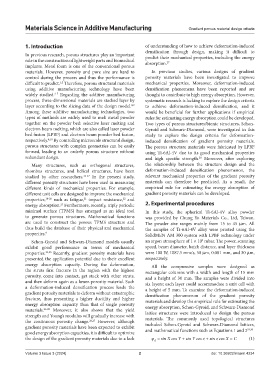
                                                               and mathematical functions such as Equations 1 and 2
            good energy absorption capacities, it is difficult to optimize
            the design of the gradient porosity materials due to a lack   φ  = sin X cos Y + sin Y cos z + sin z cos X = C  (1)
                                                                   G
            Volume 3 Issue 3 (2024)                         2                              doi: 10.36922/msam.4234

