


Page 77 - MSAM-3-3
P. 77
Materials Science in Additive Manufacturing                          Gradient porous material design criteria


            Table 1. Mechanical properties of Schon‑Gyroid‑sheet and Schwarz‑Diamond‑sheet uniform porosity materials
            Porosity       Young’s         Yield stress   Maximum        Strain at the first   Energy absorption at the
            (%)          modulus (GPa)      (MPa)        stress (MPa)     stress drop (%)   first stress drop (MJ/m )
                                                                                                           3
            Schon-Gyroid-sheet uniform porosity materials
             50            29.10±0.32      342.36±2.65    412.06±2.37      13.38±0.22            41.95±1.33
             60            23.99±0.13      248.95±3.69    291.72±3.70      12.92±0.12            27.57±3.56
             70            19.91±0.66      168.27±7.65    195.88±7.58      12.58±0.63            18.46±1.35
             80            14.01±0.26      104.12±1.26    121.61±3.89       8.55±0.85            7.73±0.69
             90            8.66±0.11       53.59±4.67     60.22±3.28        6.43±0.15            3.12±0.07
            Schwarz-Diamond-sheet uniform porosity materials
             50            30.43±0.43      380.17±7.65    429.36±3.26      11.11±0.12            34.44±1.23
             60            26.06±0.86      286.82±6.32    318.40±4.26       9.90±0.36            22.89±2.64
             70            24.01±0.13      202.77±4.21    228.99±7.42       8.43±0.38            14.41±1.03
             80            18.07±0.72      135.93±4.59    152.01±3.85       7.21±0.32            8.14±0.64
             90            12.38±0.85      84.46±1.03     89.72±2.57        6.82±0.21            4.08±0.12


                        A                                    B


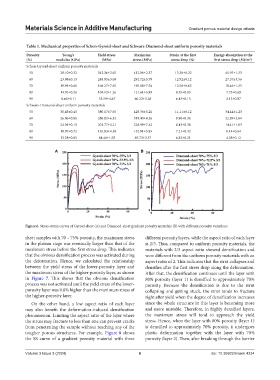
            Figure 6. Stress-strain curves of Gyroid-sheet (A) and Diamond-sheet gradient porosity materials (B) with different porosity variations

            sheet samples with 70 – 75% porosity, the maximum stress   different porosity layers, while the aspect ratio of each layer
            in the plateau stage was eventually larger than that of the   is 2/3. Thus, compared to uniform porosity materials, the
            maximum stress before the first stress drop. This indicates   materials with 2/3 aspect ratio showed densification and
            that the obvious densification process was activated during   were different from the uniform porosity materials with an
            the deformation. Hence, we calculated the relationship   aspect ratio of 2. This indicates that the strut collapses and
            between the yield stress of the lower-porosity layer and   densifies after the first stress drop along the deformation.
            the maximum stress of the higher-porosity layer, as shown   After that, the densification continues until the layer with
            in  Figure  7. This shows that the obvious densification   80% porosity (layer 1) is densified to approximately 70%
            process was not activated until the yield stress of the lower-  porosity. Because the densification is due to the strut
            porosity layer was 9.8% higher than the maximum stress of   collapsing and getting stuck, the strut tends to fracture
            the higher-porosity layer.                         right after yield when the degree of densification increases
              On  the  other  hand,  a low  aspect  ratio  of  each  layer   since the whole structure in this layer is becoming more
            may also benefit the deformation-induced densification   and more unstable. Therefore, in highly densified layers,
            phenomenon. Limiting the aspect ratio of the layer where   the maximum stress will tend to approach the yield
            the struts may fracture to less than one can prevent cracks   stress. Hence, when the layer with 80% porosity (layer 1)
            from penetrating the sample without reaching any of the   is densified to approximately 70% porosity, it undergoes
            tougher porous structures. For example,  Figure  8 shows   plastic deformation together with the layer with 70%
            the SS curve of a gradient porosity material with three   porosity (layer 2). Then, after breaking through the barrier


            Volume 3 Issue 3 (2024)                         6                              doi: 10.36922/msam.4234

