


Page 80 - MSAM-3-3
P. 80
Materials Science in Additive Manufacturing                          Gradient porous material design criteria


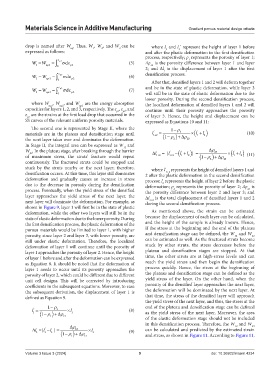
            drop is named after W . Thus, W , W , and W can be   where l  and l ’ represent the height of layer 1 before
                                            2
                                                    3
                               uρ
                                         1
                                                                        1
                                                                             1
            expressed as follows:                              and after the plastic deformation in the first densification
                                                               process, respectively; ρ  represents the porosity of layer 1;
                                                                                 1
               W = W u 1 ∫  ε ρ 1 σεd  ρ 1              (5)    ∆ρ  is the porosity difference between layer 1 and layer
                       =
                                                                 12
                1
                     ρ
                         0
                                                               2; and  ∆l  is the displacement of layer 1 after the first
                                                                       1
               W = W u 2 ∫  ε ρ 2 σεd  ρ 2              (6)    densification process.
                       =
                2
                     ρ
                          0
                                                                 After that, densified layers 1 and 2 will deform together
               W = W u 3 ∫ 0 ε ρ 3 σεd  ρ 3             (7)    and be in the state of plastic deformation, while layer 3
                       =
                                                               will still be in the state of elastic deformation due to the
                3
                     ρ
                                                               lower porosity. During the second densification process,
              where W , W , and W  are the energy absorption   the localized deformation of densified layers 1 and 2 will
                      uρ1
                                   uρ3
                          uρ2
            capacities for layers 1, 2, and 3, respectively. The ε , ε , and   continue until their porosity approaches the porosity
                                                     ρ2
                                                   ρ1
            ε  are the strains at the first load drop that occurred in the   of layer 3. Hence, the height and displacement can be
             ρ3
            SS curves of the relevant uniform porosity materials.  expressed as Equations 10 and 11:
              The second one is represented by Stage II, where the        1− ρ
                                                                                     1 (
                                                                                     ’
                                                                                       l
                                                                  ’
            materials are in the plateau and densification stage until   l 12+  = ( 1− ρ  2  ×  l + )     (10)
                                                                                        2
            the next layer takes over and dominates the deformation.       2 ) +∆ρ 23
            In Stage II, the integral area can be expressed as W  and
                                                      12
            W . In the plateau stage, after breaking through the barrier   ∆  = l  |l '  −  ( + l '  ) | = l  ∆ ρ 23  ×  ( + l '  l
              23
                                                                    +
                                                                          +
            of maximum stress, the struts’ fracture would repeat   12    12   1  2    ( − ρ  2 ) +∆ ρ  23  1  2 ) (11)
                                                                                       1
            continuously. The fractured struts could be stopped and
            stuck by the struts nearby or the next layer; therefore,   where l’  represents the height of densified layers 1 and
                                                                        1+2
            densification occurs. At this time, this layer still dominates   2 after the plastic deformation in the second densification
            deformation and gradually causes an increase in stress   process; l  represents the height of layer 2 before the plastic
                                                                      2
            due to the decrease in porosity during the densification   deformation; ρ  represents the porosity of layer 2; ∆ρ  is
                                                                                                          23
                                                                           2
            process. Eventually, when the yield stress of the densified   the porosity difference between layer 2 and layer 3; and
            layer approaches the yield stress of the next layer, the   ∆l  is the total displacement of densified layers 1 and 2
                                                                 1+2
            next layer will dominate the deformation. For example, as   during the second densification process.
            shown in Figure 9, layer 1 will first be in the state of plastic
            deformation, while the other two layers will still be in the   As mentioned above, the strain can be estimated
            state of elastic deformation due to the lower porosity. During   because the displacement of each layer can be calculated,
            the first densification process, the plastic deformation of the   and the height of the sample is already known. Hence,
            porous materials would be limited to layer 1, with higher   if the stress at the beginning and the end of the plateau
            porosity, since layer 2 and layer 3, with lower porosity, are   and densification stage can be defined, the W  and W
                                                                                                            23
                                                                                                     12
            still under elastic deformation. Therefore, the localized   can be estimated as well. As the fractured struts become
            deformation of layer 1 will continue until the porosity of   stuck by other struts, the stress decreases before the
            layer 1 approaches the porosity of layer 2. Hence, the height   plateau and densification stages are stopped. At that
            of layer 1 before and after the deformation can be expressed   time, the other struts are at high-stress levels and can
            as Equation 8. It should be noted that the deformation of   reach  the yield  stress and  then begin  the  densification
            layer 1 needs to occur until its porosity approaches the   process quickly. Hence, the stress at the beginning of
            porosity of layer 2, which could be different due to different   the plateau and densification stage can be defined as the
            unit cell designs. This  will  be corrected by  introducing   yield  stress  of the  layer.  On the other  hand, when  the
            coefficients in the subsequent equations. Moreover, to ease   porosity of the densified layer approaches the next layer,
            the subsequent derivation, the displacement of layer 1 is   the deformation will be dominated by the next layer. At
            defined as Equation 9.                             that time, the stress of the densified layer will approach
                                                               the yield stress of the next layer, and thus, the stress at the
                     1− ρ                                      end of the plateau and densification stage can be defined
               l = ( 1− ρ  1   l ×  1                   (8)    as the yield stress of the next layer. Moreover, the area
               ’
               1
                      1 ) +∆ρ
                            12
                                                               of the elastic deformation stage should not be included
                                                               in this densification process. Therefore, the W  and W
                               ∆ ρ                                                                   12     23
                   | −l
                l
               ∆= l '   | =      12    ×l               (9)    can be calculated and predicted by the estimated strain
                1
                       1
                    1
                           1
                           ( − ρ  1 ) +∆ ρ  12  1              and stress, as shown in Figure 11. According to Figure 11,
            Volume 3 Issue 3 (2024)                         9                              doi: 10.36922/msam.4234

