


Page 85 - MSAM-3-3
P. 85
Materials Science in Additive Manufacturing                          Gradient porous material design criteria


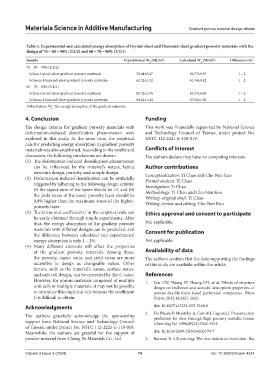
            Table 5. Experimental and calculated energy absorption of Gyroid‑sheet and Diamond‑sheet gradient porosity materials with the
            design of 70 – 80 – 90% (2/2/2) and 60 – 70 – 80% (3/2/1)
            Sample                                    Experimental W  (MJ/m )  Calculated W  (MJ/m )  Difference (%)
                                                                      3
                                                                                            3
                                                                 g                    g
            70 – 80 – 90% (2/2/2)
             Schon-Gyroid-sheet gradient porosity materials  58.04±0.27           56.77±0.93          1 – 2
             Schwarz-Diamond-sheet gradient porosity materials  62.32±1.32        61.34±0.42          1 – 2
            60 – 70 – 80% (3/2/1)
             Schon-Gyroid-sheet gradient porosity materials  86.72±1.96           85.57±0.68          1 – 2
             Schwarz-Diamond-sheet gradient porosity materials  88.42±1.24        87.82±1.06          1 – 2
            Abbreviation: W : The energy absorption of the gradient materials.
                       g
            4. Conclusion                                      Funding

            The  design  criteria  for  gradient  porosity  materials  with   This work was financially supported by National Science
            deformation-induced densification phenomenon were   and Technology Council of Taiwan, under project No.
            explored in this study. At the same time, the empirical   NSTC 112-2221-E-110-019.
            rule for predicting energy absorption in gradient porosity
            materials was also established. According to the results and   Conflicts of interest
            discussion, the following conclusions are drawn:   The authors declare they have no competing interests.
            (1) The deformation-induced densification phenomenon
               can be influenced by the material’s nature, lattice  Author contributions
               structure design, porosity, and sample design.
            (2) Deformation-induced densification can be artificially  Conceptualization: Yi Chao and Che-Nan Kuo
                                                               Formal analysis: Yi Chao
               triggered by adhering to the following design criteria:  Investigation: Yi Chao
               (i) the aspect ratio of the layers should be <1, and (ii)  Methodology: Yi Chao and Che-Nan Kuo
               the yield stress of the lower porosity layer should be  Writing–original draft: Yi Chao
               9.8% higher than the maximum stress of the higher-  Writing–review and editing: Che-Nan Kuo
               porosity layer.
            (3) The terms and coefficient C in the empirical rule can  Ethics approval and consent to participate
               be easily obtained through simple experiments. After
               that, the energy absorption of the gradient porosity  Not applicable.
               materials with different designs can be predicted, and  Consent for publication
               the difference between calculated and experimental
               energy absorption is only 1 – 2%.               Not applicable.
            (4) Many different elements will affect the properties
               of the gradient porosity materials. Among these,  Availability of data
               the porosity, aspect ratio, and yield stress are more  The authors confirm that the data supporting the findings
               accessible to design as changeable values. Other  of this study are available within the article.
               factors, such as the material’s nature, surface issues,
               and unit cell design, can be corrected by the C value.  References
               However, for porous materials composed of multiple  1.  Lou CW, Huang SY, Huang CH, et al. Effects of structure
               unit cells or multiple materials, it may not be possible  design on resilience and acoustic absorption properties of
               to introduce this empirical rule because the coefficient   porous flexible-foam based perforated composites.  Fibers
               C is difficult to obtain.                          Polym. 2015;16:2652-2662.

            Acknowledgments                                       doi: 10.1007/s12221-015-5164-6
                                                               2.  Du Plessis P, Montillet A, Comiti J, Legrand J. Pressure drop
            The authors gratefully acknowledge the sponsorship    prediction for flow through high porosity metallic foams.
            support from National Science and Technology Council   Chem Eng Sci. 1994;49(21):3545-3553.
            of Taiwan, under project No. NSTC 112-2221-E-110-019.
            Meanwhile, the  authors  are  grateful for  the  support  of   doi: 10.1016/0009-2509(94)00170-7
            powder material from Chung Yo Materials Co., Ltd.  3.  Berman B. 3-D printing: The new industrial revolution. Bus


            Volume 3 Issue 3 (2024)                         14                             doi: 10.36922/msam.4234

