


Page 96 - MSAM-3-3
P. 96
Materials Science in Additive Manufacturing                     Wide-angle broadband MMA with CB-CIP/PLA


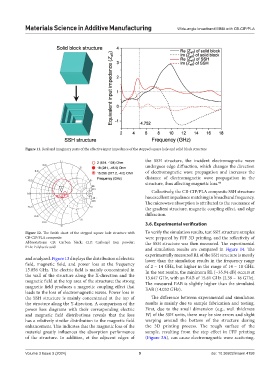
            Figure 11. Real and imaginary parts of the effective input impedance of the stepped square hole and solid block structure

                                                               the SSH structure, the incident electromagnetic wave
                                                               undergoes edge diffraction, which changes the direction
                                                               of electromagnetic wave propagation and increases the
                                                               distance of electromagnetic wave propagation in the
                                                               structure, thus affecting magnetic loss. 44
                                                                 Collectively, the CB-CIP/PLA composite SSH structure
                                                               has excellent impedance matching in broadband frequency.
                                                               The microwave absorption is attributed to the resonance of
                                                               the gradient structure, magnetic coupling effect, and edge
                                                               diffraction.

                                                               3.6. Experimental verification
            Figure  12. The Smith  chart of the stepped square hole structure with   To verify the simulation results, test SSH structure samples
            CB-CIP/PLA composite                               were prepared by FFF 3D printing, and the reflectivity of
            Abbreviations: CB: Carbon black; CIP: Carbonyl iron powder;   the SSH structure was then measured. The experimental
            PLA: Polylactic acid
                                                               and  simulation results are  compared in  Figure  14.  The
                                                               experimentally measured RL of the SSH structure is mostly
            and analyzed. Figure 13 displays the distribution of electric   lower than the simulation results in the frequency range
            field, magnetic field, and power loss at the frequency   of 2 – 14 GHz, but higher in the range of 14 – 18 GHz.
            15.056 GHz. The electric field is mainly concentrated in   In the test results, the minimum RL (−35.94 dB) occurs at
            the  wall of  the structure  along the X-direction and  the   13.647 GHz, with an EAB of 15.61 GHz (2.39 – 18 GHz).
            magnetic field at the top area of the structure; the strong   The measured EAB is slightly higher than the simulated
            magnetic field produces a magnetic coupling effect that   EAB (14.032 GHz).
            leads to the loss of electromagnetic waves. Power loss in
            the SSH structure is mainly concentrated at the top of   The difference between experimental and simulation
            the structure along the Y-direction. A comparison of the   results is mainly due to sample fabrication and testing.
            power loss  diagrams with their corresponding electric   First, due  to the  small  dimension (e.g.,  wall  thickness
            and magnetic field distributions reveals that the loss   W) of the SSH units, there may be size errors and slight
            has a relatively similar distribution to the magnetic field   warping  around  the  bottom  of  the  structure  during
            enhancement. This indicates that the magnetic loss of the   the 3D printing process. The rough surface of the
            material greatly influences the absorption performance   sample, resulting from the step effect in FFF printing
            of the structure. In addition, at the adjacent edges of   (Figure 3A), can cause electromagnetic wave scattering.


            Volume 3 Issue 3 (2024)                         9                              doi: 10.36922/msam.4158

