


Page 92 - MSAM-3-3
P. 92
Materials Science in Additive Manufacturing                     Wide-angle broadband MMA with CB-CIP/PLA


                         A                                     B


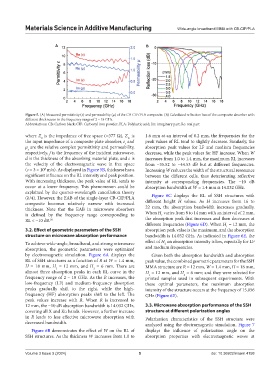
            Figure 5. (A) Measured permittivity (ε) and permeability (μ) of the CB-CIP/PLA composite. (B) Calculated reflection loss of the composite absorber with
            different thicknesses in the frequency range of 2 – 18 GHz
            Abbreviations: CB: Carbon black; CIP: Carbonyl iron powder; PLA: Polylactic acid; Im: imaginary part; Re: real part

            where Z  is the impedance of free space (≈377 Ω), Z  is   1.6 mm at an interval of 0.2 mm, the frequencies for the
                   0
                                                       in
            the input impedance of a composite plate absorber, ε  and   peak values of RL tend to slightly decrease. Similarly, the
                                                      r
            μ  are the relative complex permittivity and permeability,   absorption peak values for LF and medium frequencies
             r
            respectively, f is the frequency of the incident microwave,   decrease, while the peak values for HF increase. When W
            d is the thickness of the absorbing material plate, and c is   increases from 1.0 to 1.4 mm, the maximum RL increases
            the velocity of the electromagnetic wave in free space   from −35.52 to −44.53  dB but at different frequencies.
            (c = 3 × 10  m/s). As displayed in Figure 5B, thickness has a   Increasing W reduces the width of the structural resonance
                    8
            significant influence on the RL intensity and peak position.   between the  different cells, thus  deteriorating reflective
            With increasing thickness, the peak value of RL tends to   intensity at corresponding frequencies. The −10  dB
            occur at a lower frequency. This phenomenon could be   absorption bandwidth at W = 1.4 mm is 14.032 GHz.
            explained by the quarter-wavelength cancellation theory
            (λ/4). However, the EAB of the single-layer CB-CIP/PLA   Figure  6C displays the RL of SSH structures with
            composite becomes relatively narrow with increased   different height  H values.  As  H increases from 16 to
            thickness. Note that the EAB in microwave absorbers   22  mm, the absorption bandwidth increases gradually.
            is defined by the frequency range corresponding to   When H  varies from 8 to 14 mm with an interval of 2 mm,
                                                                      1
            RL < −10 dB. 38                                    the absorption peak first increases and then decreases at
                                                               different frequencies (Figure 6D). When H  = 12 mm, the
                                                                                                 1
            3.2. Effect of geometric parameters of the SSH     absorption peak value is the maximum, and the absorption
            structure on microwave absorption performance      bandwidth is 14.032 GHz. As indicated in Figure 6E, the
            To achieve wide-angle, broadband, and strong microwave   effect of H  on absorption intensity is low, especially for LF
                                                                       2
            absorption, the geometric parameters were optimized   and medium frequencies.
            by electromagnetic simulation.  Figure  6A displays the   Given both the absorption bandwidth and absorption
            RL of SSH structures as a function of R at W = 1.4 mm,   peak value, the combined geometric parameters for the SSH
            H  =  18  mm,  H  = 12  mm, and  H  = 6  mm. There are   MMA structure are R = 12 mm, W = 1.4 mm, H = 18 mm,
                         1
                                         2
            almost three absorption peaks in each RL curve in the   H  = 12 mm, and H  = 6 mm; and they were selected for
                                                                1
                                                                               2
            frequency range of 2 – 18 GHz. As the R increases, the   printed samples used in subsequent experiments. With
            low-frequency (LF) and  medium-frequency absorption   these  optimal  parameters,  the  maximum  absorption
            peaks gradually shift to the right, while the high-  intensity of the structure occurs at the frequency of 15.056
            frequency (HF) absorption peaks shift to the left. The   GHz (Figure 6E).
            peak values increase with  R. When  R is increased to
            12 mm, the −10 dB absorption bandwidth is 14.032 GHz,   3.3. Microwave absorption performance of the SSH
            covering all X and Ku bands. However, a further increase   structure at different polarization angles
            in  R leads to less effective microwave absorption with   Polarization characteristics of the SSH structure were
            decreased bandwidth.                               analyzed using the electromagnetic simulation.  Figure  7
              Figure 6B demonstrates the effect of W on the RL of   displays the influence of polarization angle on the
            SSH structures. As the thickness W increases from 1.0 to   absorption properties with electromagnetic waves at


            Volume 3 Issue 3 (2024)                         5                              doi: 10.36922/msam.4158

