


Page 95 - MSAM-3-3
P. 95
Materials Science in Additive Manufacturing                     Wide-angle broadband MMA with CB-CIP/PLA


            At an incident angle of 50°, the bandwidth is 12.46 GHz.   To further analyze the impedance matching performance
            Therefore, the SSH structure maintains good absorption   of the SSH absorber, 42,43  the effective input impedance (Z )
                                                                                                           eff
            properties even when the incident angle changes in the TE   of the structure was calculated,
            and TM polarization modes.
                                                                            2
                                                                     (1 + S ) − S 2
            3.5. Absorption mechanism                          Z eff  =   11  2  21                       (V)
                                                                               2
                                                                          11
              The absorption mechanism of the designed SSH           (1 − S ) − S 21
            structure was analyzed. Good impedance matching of the   where  S  is the reflection coefficient and  S  is the
                                                                      11
                                                                                                      21
            structure is essential for effective broadband microwave   transmission coefficient. An SSH structure is formed in a
            attenuation. The impedance matching (Z) and attenuation   process of material reduction by cutting holes layer-by-layer
            constant (α) can be calculated as follows: 40,41   into a solid block to create gradient effects. The Z  of the
                                                                                                       eff
                                                               solid block was also calculated for comparison (Figure 11).
                Z
            Z =  in  = r +  jx                         (III)   For the SSH structure, there are large fluctuations of Z  in
                                                                                                          eff
                Z 0                                            the frequency range of 2 – 4.75 GHz, and the impedance
                                                               mismatch leads to poor absorption in this frequency range.
                                                               The real and imaginary parts of Z  in the frequency range
                                                                                          eff
                                              2
                                       ’’
                                           ’
                                             ’
                                      ’’
                 2 π f              ( µε − µε )                of 4.75 – 18 GHz become close to 1 and 0, respectively,
                        ’’
                               ’
                              ’
                          ’’
            α =       ( µε − µε ) +                            indicating a good impedance match between the SSH
                  c                 +( µε + µε ) 2     (IV)    structure and free space in this frequency range. In the
                                            ’
                                              ’’
                                       ’’
                                         ’
                                                               solid block, the real and imaginary parts of Z  fluctuate
                                                                                                     eff
            where the real part r is the resistance, and the imaginary   greatly in the frequency range of 2 – 18 GHz, preventing
            part x is the reactance, which includes the capacitive and   effective wave absorption in this range. The SSH structure
            inductive reactance. The impedance matching of absorbing   improves the impedance matching between the structure
            materials should generally exceed 0.3. A higher Z-value,   and free space through the gradient effect of layer-by-
            e.g., close to 1, suggests better impedance matching of   layer opening holes. The large square hole at the top of
            the material. The incident wave can better transmit into   the SSH structure allows more electromagnetic waves to
            the material, thus reducing the reflection on the surface   enter the structure smoothly. Once electromagnetic waves
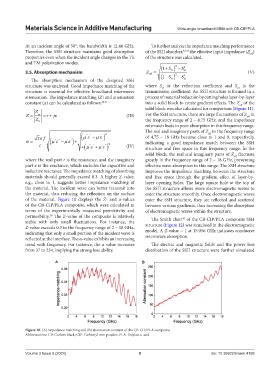
            of the material.  Figure  10 displays the  Z-  and  α-values   enter the SSH structure, they are reflected and scattered
            of the CB-CIP/PLA composite, which were calculated in   between various gradients, thus increasing the absorption
            terms of the experimentally measured permittivity and   of electromagnetic waves within the structure.
            permeability.  The Z-value of the composite is relatively   The Smith chart  of the CB-CIP/PLA composite SSH
                      38
                                                                               43
            stable with only small fluctuations. For instance, the   structure (Figure 12) was simulated in the electromagnetic
            Z-value exceeds 0.3 in the frequency range of 2 – 18 GHz,   model. A Z-value = 1 at 15.056 GHz indicates conducive
            indicating that only a small portion of the incident wave is
            reflected at the interface. The α-value exhibits an increasing   microwave absorption.
            trend with frequency. For instance, the α value increases   The electric and magnetic fields and the power loss
            from 37 to 234, implying the strong loss ability.  distribution of the SSH structure were further simulated
                         A                                   B


            Figure 10. (A) Impedance matching and (B) attenuation constant of the CB-CIP/PLA composite
            Abbreviations: CB: Carbon black; CIP: Carbonyl iron powder; PLA: Polylactic acid


            Volume 3 Issue 3 (2024)                         8                              doi: 10.36922/msam.4158

