


Page 105 - OR-1-1
P. 105
until it turned milky white, incubated at 4°C for 10 min, and   2.5.4. Flow cytometry
            then centrifuged at 12,000 ×g at 4°C for 15 min. The upper   The harvested cells were first centrifuged, and the
            aqueous phase was carefully transferred into a new 1.5 mL   supernatant was discarded. The cells were then washed once
            tube. Isopropanol was added to the sample in a 1:1 ratio, and   with PBS, and the wash supernatant was also discarded.
            the mixture was inverted 10 times before being incubated at   The cells were resuspended in PBS and mixed thoroughly.
            4°C for 10 min. The sample was then centrifuged at 12,000   Approximately 1 × 10⁶ cells were transferred to a centrifuge
            × g at 4°C for 10 min, and the supernatant was discarded.   tube  and  incubated  with  100  μL  of  primary  antibodies
            The pellet was washed with 1 mL of DEPC water containing   against Col II and ACAN for 60 min. After incubation, the
            75% (v/v) ethanol and centrifuged at 7,500 × g at 4°C for   cells were centrifuged, and the supernatant was discarded.
            5  min. After discarding the supernatant, the tube was   The pellet was washed again with PBS and then incubated
            inverted onto a paper towel and allowed to dry for 10 min.   with 100  μL of Alexa Fluor 594  secondary antibody for
            Finally, the pellet was resuspended in 10 μL of DEPC water.   30  min. Following another round of centrifugation and
            A 2 μL sample was loaded onto a Cytation 5 microplate for   PBS washing, the cells were resuspended in 200  μL of
            RNA concentration measurement, with 2 μL of DEPC water   PBS and prepared for flow cytometric analysis. Data were
            used as the control. A reverse transcription kit was used   subsequently analyzed using FlowJo software.
            to prepare the cDNA template. Fluorescent PCR kits were
            employed for reverse transcription, and the Ct values for   2.6. Inflammation simulation
            each gene were obtained using a fluorescence quantitative   Following stabilization of the cellular microenvironment, on
            PCR instrument. The ΔCt values of the target gene (Col II,   day 4, 10 ng/mL of IL-1β was added to the growth medium,
            ACAN) in each group (2D; 2D + microfluidics; 3D) were   as described in previous studies.  On day 7 (Figure 3A),
                                                                                        18
            calculated as follows:
                                                              post-cell extraction, TUNEL staining, Alcian blue-safranin
               ΔCt = Ct (target gene) - Ct (GAPDH)      (II)  staining, SO/FG staining, and immunofluorescence staining
               The reference used for each target gene is defined as   were performed to validate inflammation induction.
            follows:                                          2.6.1. TUNEL staining
                     ΔΔCt = ΔCt (2D; 2D + microfluidics; 3D)    After gently shaking the slides to remove excess liquid, a
                           - ΔCt   (control)            (III)  hydrophobic barrier pen was used to draw circles around
               Expression level = 2 -ΔΔCt               (IV)  evenly distributed cells on the cover glass to prevent
                                                              antibody leakage. Each sample was then immersed in
               The  process  was  repeated 3  times  to  ensure  the
            consistency and reliability of the results. The average value   a permeabilization solution and incubated at room
                                                              temperature for 5 min to facilitate permeabilization. The
            of the three independent experiments was then calculated   samples were washed 3  times with phosphate-buffered
            to obtain a more accurate representation of the gene   saline (PBS), each wash lasting 5  min. After removing
            expression levels across different conditions. This repetition   the excess liquid, the buffer was added within the circles
            helps to minimize experimental errors and ensures that the   to cover the tissue and incubated at room temperature for
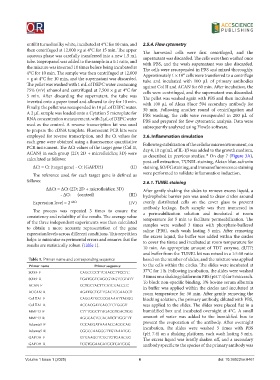
            results are statistically robust (Table 1).
                                                              10  min. An appropriate amount of TDT enzyme, dUTP,
                                                              and buffer from the TUNEL kit was mixed in a 1:5:50 ratio
             Table 1. Primer name and corresponding sequence  based on the number of slides, and the mixture was applied
             Primer name                 Primer sequence      to the cells within the circles. The slides were incubated at
             SOX9-F                CAGCCCCTTCAACCTTCCTC       37°C for 1 h. Following incubation, the slides were washed
             SOX9-R                TGATGGTCAGCGTAGTCGTATT     3 times on a shaking platform in PBS (pH 7.4) for 5 min each.
                                                              To block non-specific binding, 3% bovine serum albumin
             ACAN-F                CCTGCTACTTCATCGACCCC       in buffer was applied within the circles and incubated at
             ACCAN-R               AGATGCTGTTGACTCGAACCT      room temperature for 30 min. After gently removing the
             Col IIA1-F            CAGGATGCCCGAAAATTAGGG      blocking solution, the primary antibody, diluted with PBS,
             Col IIA1-R            ACCACGATCACCTCTGGGT        was applied to the slides. The slides were placed flat in a
             MMP13-F               CTTTGGCTTAGAGGTGACTGG      humidified box and incubated overnight at 4°C. A small
             MMP13-R               AGGCACTCCACATCTTGGTTT      amount of water was added to the humidified box to
             Adamts5-F             CCCAGGATAAAACCAGGCAG       prevent the evaporation of the antibody. After overnight
                                                              incubation, the slides were washed 3  times with PBS
             Adamts5-R             CGGCCAAGGGTTGTAAATGG       (pH 7.4) on a shaking platform, each wash lasting 5 min.
             GAPDH-F               GTGAAGGTCGGTGTGAACGG       The excess liquid was briefly shaken off, and a secondary
             GAPDH-R               TCCTGGAAGATGGTGATGGG       antibody specific to the species of the primary antibody was


            Volume 1 Issue 1 (2025)                         6                                 doi: 10.36922/or.8461

