


Page 28 - OR-1-3
P. 28
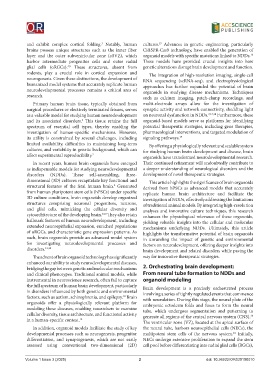
and exhibit complex cortical folding.  Notably, human   cultures.   Advances  in  genetic  engineering,  particularly
                                                                     15
                                            3
            brains possess unique structures such as the inner fiber   CRISPR-Cas9 technology, have enabled the generation of
                                                                                                            16
            layer and the outer subventricular zone (oSVZ), which   organoid models with specific mutations linked to NDDs.
            harbor intermediate progenitor cells and outer radial   These models have provided crucial insights into how
            glial cells (oRGCs).  These structures, absent from   genetic alterations disrupt brain development and function.
                              4,5
            rodents, play a crucial role in cortical expansion and   The integration of high-resolution imaging, single-cell
            neurogenesis. Given these distinctions, the development of   RNA sequencing (scRNA-seq), and electrophysiological
            humanized model systems that accurately replicate human   approaches has further expanded the potential of brain
            neurodevelopmental processes remains a critical area of   organoids in studying disease mechanisms. Techniques
            research.                                         such as calcium imaging, patch-clamp recordings, and
               Primary  human  brain tissue, typically  obtained from   multi-electrode arrays allow for the investigation of
            surgical procedures or electively terminated fetuses, serves   synaptic activity and network connectivity, shedding light
            as a valuable model for studying human neurodevelopment   on neuronal dysfunction in NDDs. 7,17,18  Furthermore, these
            and its associated disorders.  This tissue retains the full   organoid-based models serve as platforms for identifying
                                    6
            spectrum of essential cell types, thereby enabling the   potential therapeutic strategies, including gene therapies,
            investigation of human-specific mechanisms. However,   pharmacological interventions, and targeted modulation of
            its utility is constrained by several challenges, including   signaling pathways. 19
            limited  availability,  difficulties  in  maintaining  long-term   By offering a physiologically relevant and scalable system
            cultures, and variability in genetic background, which can   for studying human brain development and disease, brain
            affect experimental reproducibility. 7            organoids have transformed neurodevelopmental research.
               In recent years, human brain organoids have emerged   Their continued refinement will undoubtedly contribute to
            as indispensable models for studying neurodevelopmental   a deeper understanding of neurological disorders and the
            disorders  (NDDs).  These  self-assembling,  three-  development of novel therapeutic strategies.
            dimensional (3D) cultures recapitulate key functional and   This article highlights the significance of brain organoids
            structural features of the fetal human brain.  Generated   derived from hPSCs  as advanced models that accurately
                                                  8
            from human pluripotent stem cells (hPSCs) under specific   replicate human  brain  architecture  and facilitate  the
            3D culture conditions, brain organoids develop organized   investigation of NDDs, effectively addressing the limitations
            structures comprising neuronal progenitors, neurons,   of traditional animal models. By integrating high-resolution
            and glial cells, mimicking the cellular diversity and   analyses  and innovative culture techniques,  this  research
                                            9,10
            cytoarchitecture of the developing brain.  They also retain   enhances the physiological relevance of these organoids,
            hallmark features of human neurodevelopment, including   yielding valuable insights into the cellular and molecular
            extended neuroepithelial expansion, enriched populations   mechanisms underlying NDDs. Ultimately, this article
            of oRGCs, and characteristic gene expression patterns. As   highlights the transformative potential of brain organoids
            such, brain organoids provide an advanced model system   in unraveling the impact of genetic and environmental
            for investigating neurodevelopmental processes and   factors on neurodevelopment, offering deeper insights into
            disorders. 11,12                                  brain development and related disorders while paving the

               The advent of brain organoid technology has significantly   way for innovative therapeutic strategies.
            enhanced our ability to study neurodevelopmental diseases,
            bridging the gap between genetic and molecular mechanisms   2. Orchestrating brain development:
            and clinical phenotypes. Traditional animal models, while  From neural tube formation to NDDs and
            instrumental in neuroscience research, often fail to capture  organoid modeling
            the full spectrum of human brain development, particularly   Brain development is a precisely orchestrated process
            in disorders influenced by both genetic and environmental   involving a series of tightly regulated events that commence
            factors, such as autism, schizophrenia, and epilepsy.  Brain   with neurulation. During this stage, the neural plate of the
                                                     13
            organoids offer a physiologically relevant platform for   embryonic ectoderm folds and fuses to form the neural
            modeling these diseases, enabling researchers to examine   tube, which undergoes segmentation and patterning to
            cellular diversity, tissue architecture, and functional activity   generate all regions of the central nervous system (CNS).
                                                                                                            20
            in a human-specific context. 14
                                                              The ventricular zone (VZ), located at the apical surface of
               In addition, organoid models facilitate the study of key   the neural tube, harbors neuroepithelial cells (NECs), the
            developmental processes such as neurogenesis, progenitor   multipotent  stem  cells  of  the  nervous  system.   Initially,
                                                                                                    21
            differentiation, and synaptogenesis, which are not easily   NECs undergo extensive proliferation to expand the stem
            assessed using  conventional  two-dimensional  (2D)   cell pool before differentiating into radial glial cells (RGCs),


            Volume 1 Issue 3 (2025)                         2                            doi: 10.36922/OR025100010

