


Page 29 - OR-1-3
P. 29
specialized neural progenitors responsible for generating   astrocytes and oligodendrocytes, respectively. 29,30  These
            both neuronal and glial cells. 22                 glial cells  integrate into  neuronal circuits, supporting

               RGCs exhibit a highly polarized morphology with   synaptic function and maintenance.
            an apically positioned soma and elongated radial    NDDs  encompass  a broad  spectrum  of conditions
            processes extending to the pial surface. Initially, they   characterized by abnormal brain development, leading
            divide symmetrically to amplify the progenitor pool. As   to  cognitive,  emotional, and  behavioral impairments.
                                                                                                            31
            corticogenesis proceeds, RGCs transition to asymmetric   Affecting approximately 5% of children worldwide, NDDs
            divisions, producing neurons and additional RGCs in   manifest with diverse clinical features, including intellectual
            a process termed direct neurogenesis. 23,24  Alternatively,   disability, autism spectrum disorder, and developmental
            asymmetric divisions generate intermediate progenitor   delays.  Their etiology is multifactorial, involving intricate
                                                                   32
            cells in the subventricular zone (SVZ), which undergo   genetic and environmental interactions. Animal models,
            limited proliferation before giving rise to neurons through   particularly transgenic rodents, have been instrumental in
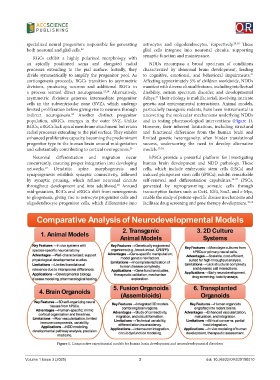
            indirect neurogenesis.  Another distinct progenitor   uncovering the molecular mechanisms underlying NDDs
                               25
            population, oRGCs, emerges in the outer SVZ. Unlike   and in testing pharmacological interventions (Figure  1).
            RGCs, oRGCs lack apical membrane attachment but retain   However,  their  inherent  limitations,  including  structural
            radial processes extending to the pial surface. They exhibit   and functional differences from the human brain and
            enhanced proliferative capacity, becoming the predominant   limited genetic heterogeneity, often hinder translational
            progenitor type in the human brain around mid-gestation   success, underscoring the need to develop alternative
            and substantially contributing to cortical neurogenesis. 26  models. 33,34
               Neuronal differentiation and migration occur     hPSCs provide a powerful platform for investigating
            concurrently, ensuring proper integration into developing   human brain development and NDD pathology. These
            networks. 27  Dendritic  spine  morphogenesis  and  cells, which include embryonic stem cells (ESCs) and
            synaptogenesis establish synaptic connectivity, followed   induced pluripotent stem cells (iPSCs), exhibit remarkable
            by synaptic pruning, which refines neuronal circuits   self-renewal and differentiation capabilities. 35-37  iPSCs,
            throughout development and into adulthood.  Around   generated by reprogramming somatic cells through
                                                   28
            mid-gestation, RGCs and oRGCs shift from neurogenesis   transcription factors such as Oct4, Klf4, Sox2, and c-Myc,
            to gliogenesis, giving rise to astrocyte progenitor cells and   enable the study of patient-specific disease mechanisms and
            oligodendrocyte progenitor cells, which differentiate into   facilitate drug screening and gene therapy development. 38,39


                         Figure 1. Comparative experimental models for human brain development and neurodevelopmental disorders


            Volume 1 Issue 3 (2025)                         3                            doi: 10.36922/OR025100010

